



Imagine if you could recall your mother’s smile when you said your first word or the smell of the candles on your second birthday cake. These precious moments, often lost to time, fall under the phenomenon known as infantile amnesia. Despite our best efforts, almost nobody can recall memories from very early childhood. So, why does this happen?
The Brain’s Developmental Journey
It’s not because we don’t retain information as young children. In fact, young children do remember facts in the moment, like recognizing their parents or knowing to say “please” to get candy. This is called “semantic memory.” However, until children reach the ages of 2 to 4, they generally lack “episodic memory” — the detailed recall of specific events.
Episodic memories are stored in various parts of the brain’s surface, or cortex. For instance, auditory memories are processed in the auditory cortex, and visual memories in the visual cortex. The hippocampus, a small yet crucial region of the brain, ties all these scattered pieces together. Think of the cortex as a flower bed and the hippocampus as the one tying the flowers into a bouquet — that bouquet is the memory.
The Role of the Hippocampus
According to Patricia Bauer, a psychology professor at Emory University, the hippocampus is responsible for integrating these fragments into a cohesive memory. Before the hippocampus matures enough to perform this function, children might find episodic memory unnecessarily complex while they are still learning about the world around them. Hence, early childhood focuses more on acquiring semantic knowledge.
Did You Know?
Sheldon Cooper from “Young Sheldon” is a character known for his remarkable memory, recalling events from his infancy. Though fictional, Sheldon represents the rare cases of individuals with extraordinary memory capabilities. 
Can Early Memories Be Recalled?
Interestingly, another theory posits that we do store these early memories but struggle to recall them as adults. A 2023 study published in the journal Science Advances showed that “forgotten” childhood memories could be reinstated in adult mice by stimulating specific neural pathways with light. The study found that mice with characteristics of autism spectrum disorder (ASD) could recall memories from their early days, suggesting that immune activation during pregnancy might influence memory retention.
Memory Marvels: Real-Life Cases
While rare, there are individuals who claim to remember their early childhood years. For example, Rebecca Sharrock, an Australian woman, has a condition called Highly Superior Autobiographical Memory (HSAM). She can recall nearly every day of her life, including her infancy. It’s thought that only around 60-80 people in the world have it. Her case provides valuable insights into how memory works and why most of us experience infantile amnesia. 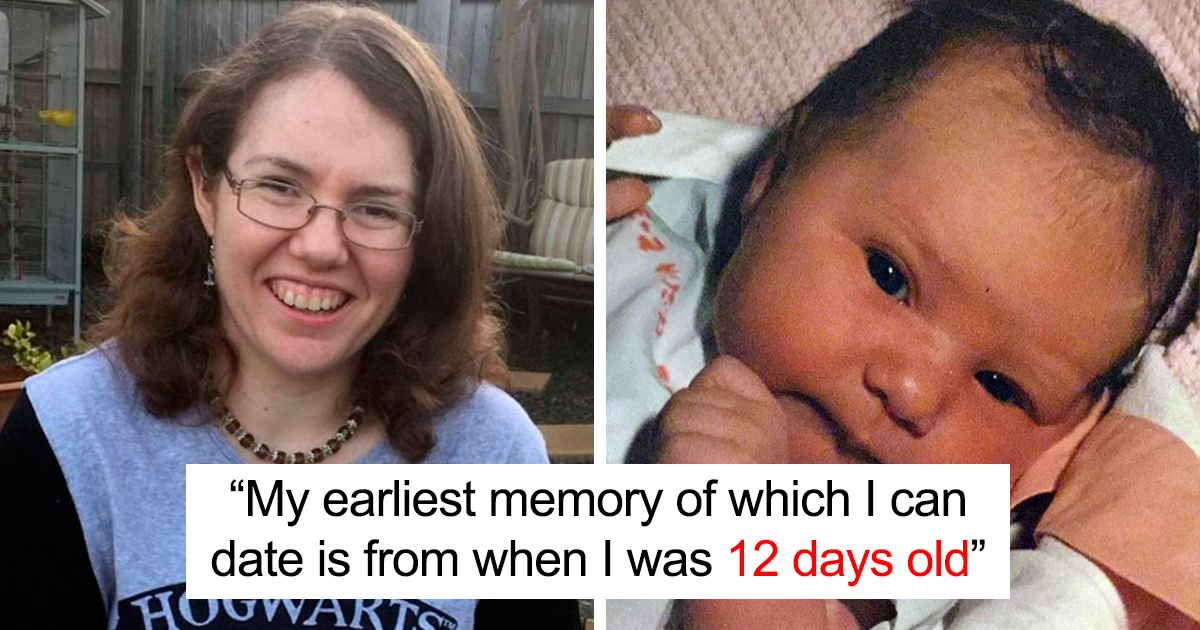
Theories and Implications
The research in mice, while not yet studied in humans, offers significant insights into memory and forgetting across child development. It suggests that early memories might not be lost but could be inaccessible due to developmental factors. This research also has implications for understanding memory in the context of autism, potentially paving the way for new cognitive therapies.
Fun Fact: The Mandela Effect
Have you ever experienced the Mandela Effect, where you remember something differently than how it occurred? This collective misremembering showcases the brain’s complex relationship with memory and how easily it can be influenced.
Why Do Smells Trigger Strong Memories?
Ever caught a whiff of something that instantly transported you back to a specific moment? That’s because the olfactory system is directly linked to the brain’s memory centres, making smells powerful triggers for recollection.
Conclusion
Infantile amnesia remains a fascinating topic, blending neuroscience, psychology, and the mysteries of human memory. While we may not remember our early years, understanding why can help us appreciate the incredible complexity of our developing brains. And who knows? Future research might one day unlock the secrets to recalling those lost memories, bringing us closer to genius minds like Sheldon Cooper and real-life memory marvels.
Stay tuned for more intriguing insights into the human brain and behavior, right here!

Leave a Comment