

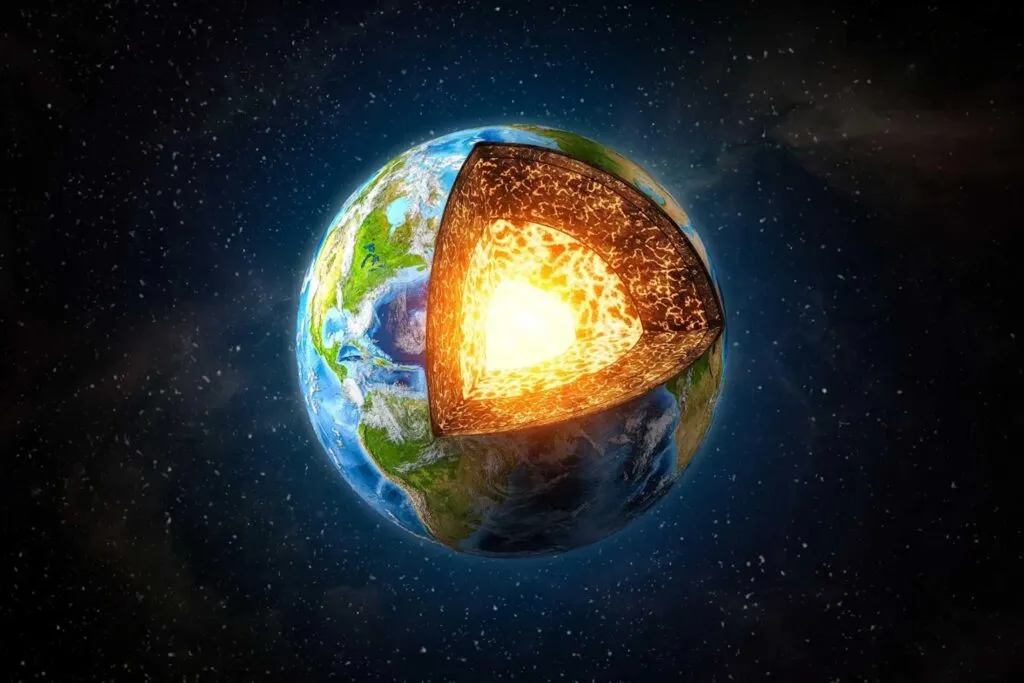

The Earth’s inner core, a solid metal ball spinning independently within our planet, has long intrigued scientists. Since its discovery by Danish seismologist Inge Lehmann in 1936, understanding the core’s rotation and its implications has been a subject of intense debate. Recently, scientists have confirmed that the inner core has slowed significantly and is now moving in reverse, a revelation that could slightly alter the length of our days.
The Hidden Mysteries of the Inner Core
The inner core, buried about 3,220 miles (5,180 kilometers) beneath Earth’s surface, is a scorching sphere primarily composed of iron and nickel, with temperatures soaring to around 9,800 degrees Fahrenheit (5,400 degrees Celsius). This core, surrounded by a liquid metal outer core, plays a crucial role in generating Earth’s magnetic field. The movement of metal-rich fluid in the outer core generates electrical currents, which in turn power the magnetic field that shields our planet from harmful solar radiation.
Decades-Long Debate and Breakthroughs
Understanding the core’s movement has been challenging due to its inaccessibility. Scientists have had to rely on seismic waves from earthquakes to gather data. By examining these waves, researchers can infer changes in the core’s position and rotation. The concept of the core’s differential rotation, where the inner core spins at a different rate than the rest of the Earth, was first proposed in the 1970s and ‘80s. However, it wasn’t until the 1990s that seismological evidence began to support this theory.
Recent research has suggested that the inner core, which once spun faster than the Earth itself, has now slowed down and is moving in reverse. A model proposed in 2023 indicated that the core’s rotation had gradually decelerated, eventually moving backward relative to the fluid layers surrounding it. This hypothesis has now received compelling support from a study published on June 12, 2024, in the journal Nature. The study confirmed that the core’s rotational speed follows a 70-year cycle, further validating the decades-long pattern of speed changes.
Implications for Earth
The implications of this slowdown are still being explored. One significant consequence is the potential impact on the Earth’s magnetic field. Although the inner core’s direct influence on the magnetic field remains unclear, a slower-spinning core could affect it and slightly shorten the length of a day. When the core spins slowly, the mantle speeds up, causing the Earth to rotate faster.
Future Research and Challenges
The new findings are a major step forward, but the mystery is far from solved. The study’s co-author, Dr. John Vidale, a professor at the University of Southern California, noted that while this research has clarified the core’s movement over the past few decades, many uncertainties remain. The depth and inaccessibility of the inner core make direct observations impossible, leaving scientists to rely on indirect methods like seismic waves from earthquakes and nuclear tests.
Researchers observed 121 earthquakes in the South Sandwich Islands between 1991 and 2023 and analyzed core-penetrating shock waves from Soviet nuclear tests conducted in the early 1970s. This data revealed that the core’s rotation varies, raising questions about the inner core’s composition and dynamics.
The confirmation that Earth’s inner core has slowed down and is now moving in reverse marks a significant advancement in our understanding of the planet’s inner workings. While the direct implications of this slowdown on our daily lives may be minimal, the ongoing research continues to unravel the complex interplay between the Earth’s core and its magnetic field. As scientists delve deeper into these mysteries, we inch closer to comprehending the profound forces shaping our planet.

Leave a Comment