

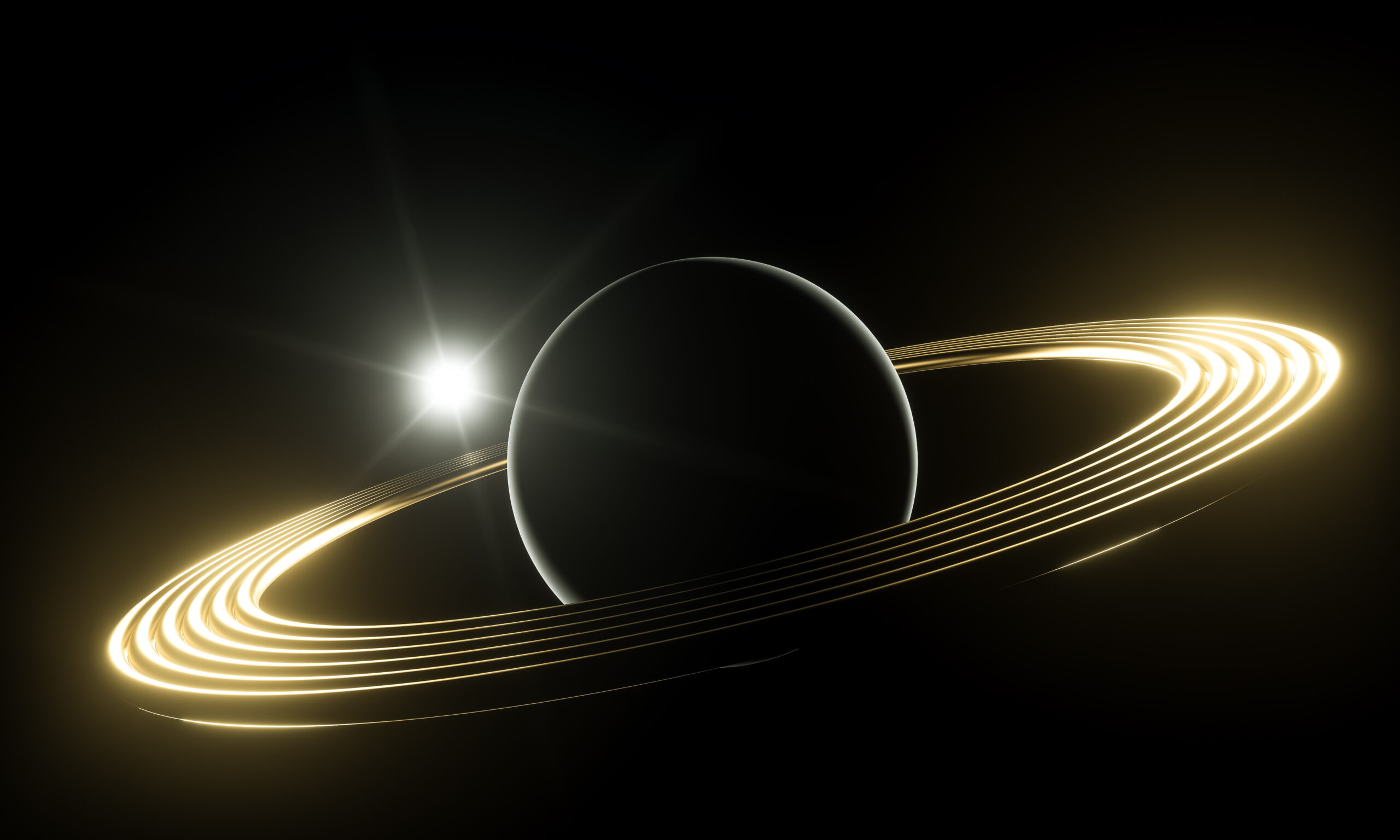

Most of us know Saturn for its stunning rings, a feature that has fascinated astronomers and stargazers for centuries. From Galileo’s first observations in the 17th century—where he thought Saturn had “ears” due to his limited telescope—to today’s advanced studies, Saturn’s rings have always been an enigma waiting to be unraveled.
But did you know that Saturn’s majestic rings will soon vanish from view? Yes, you read that right! Come March 2025, these awe-inspiring rings will become virtually invisible to observers on Earth.
Why are Saturn’s Rings Disappearing?
This is all due to Saturn’s unique axial tilt and orbit around the Sun. Just like Earth, Saturn has a tilt—in its case, around 27 degrees. This tilt causes different parts of its rings to be lit by the Sun at different angles throughout its 29.5-year orbit. And guess what? There are two brief moments in this orbit, known as equinoxes, when Saturn’s rings align edge-on with our view from Earth, making them almost invisible!
Mark Your Calendar: March 2025!
Don’t worry, though. This cosmic magic trick is temporary. Saturn’s rings will play hide-and-seek with us for a few months, reappearing after November 2025. So, if you have a telescope, make sure to catch a glimpse before they vanish!
What Are Saturn’s Rings Made Of?
Saturn’s rings aren’t just one single, solid structure. They are made up of millions of ice particles, rocky debris, and cosmic dust, ranging from tiny grains to chunks as big as a house! These are grouped into distinct sections known as the A, B, and C rings, with fainter D, E, F, and G rings adding to the complex mix.
Did You Know?
The famous Cassini Division—a 4,800-kilometer-wide gap between Saturn’s A and B rings—was discovered by the Cassini-Huygens mission. This gap is shaped by the gravitational pull of Saturn’s “shepherd moons” that orbit close to the rings and keep them in place.
The Mystery of Saturn’s Rings: How Did They Form?
There are many theories about the origin of Saturn’s rings. Some suggest they could be the remnants of a destroyed moon or a comet torn apart by Saturn’s strong gravity. Others believe they are leftover materials from when Saturn formed over 4 billion years ago! The truth? Scientists are still figuring it out, with each new discovery adding more pieces to the puzzle.
The Cassini-Huygens Mission: A Treasure Trove of Discoveries
The Cassini-Huygens mission, a joint venture by NASA, ESA, and the Italian Space Agency, was launched to unlock the mysteries of Saturn and its rings. Over 13 years of exploration from 2004 to 2017, the mission provided groundbreaking insights into Saturn’s rings, moons, and magnetic fields.
Fun Fact!
Cassini discovered that Enceladus, one of Saturn’s icy moons, has geysers shooting water vapor and organic materials—hinting at the potential for life in its subsurface oceans! Could there be life beyond Earth? Cassini’s discoveries have certainly got us wondering!
Saturn’s Moons and Magnetic Field
Saturn isn’t just about those mesmerizing rings; it also has at least 145 moons, each with its unique characteristics. Titan, the largest of them, boasts a thick atmosphere and a magnetic field stronger than Earth’s, with spectacular auroras at its poles. The upcoming Dragonfly mission is set to explore Titan even further, searching for signs of life!
Get Ready for a Celestial Show!
As Saturn’s rings prepare to vanish in March 2025, don’t miss the chance to witness this rare cosmic event. The rings will align edge-on with Earth, creating a stunning celestial display for stargazers everywhere. And remember, Saturn is always a captivating target through a telescope, with or without its rings in full view.
Trivia Time!
Did you know that Saturn’s rings could disappear entirely in about 100 million years due to gravitational forces pulling them into the planet? Catch them while you can!
Stay tuned for more fascinating cosmic events, and keep your eyes on the skies. Saturn, with all its wonder, continues to be a jewel in our solar system’s crown.
How about getting your telescope ready? Saturn’s secrets await!


Leave a Comment