

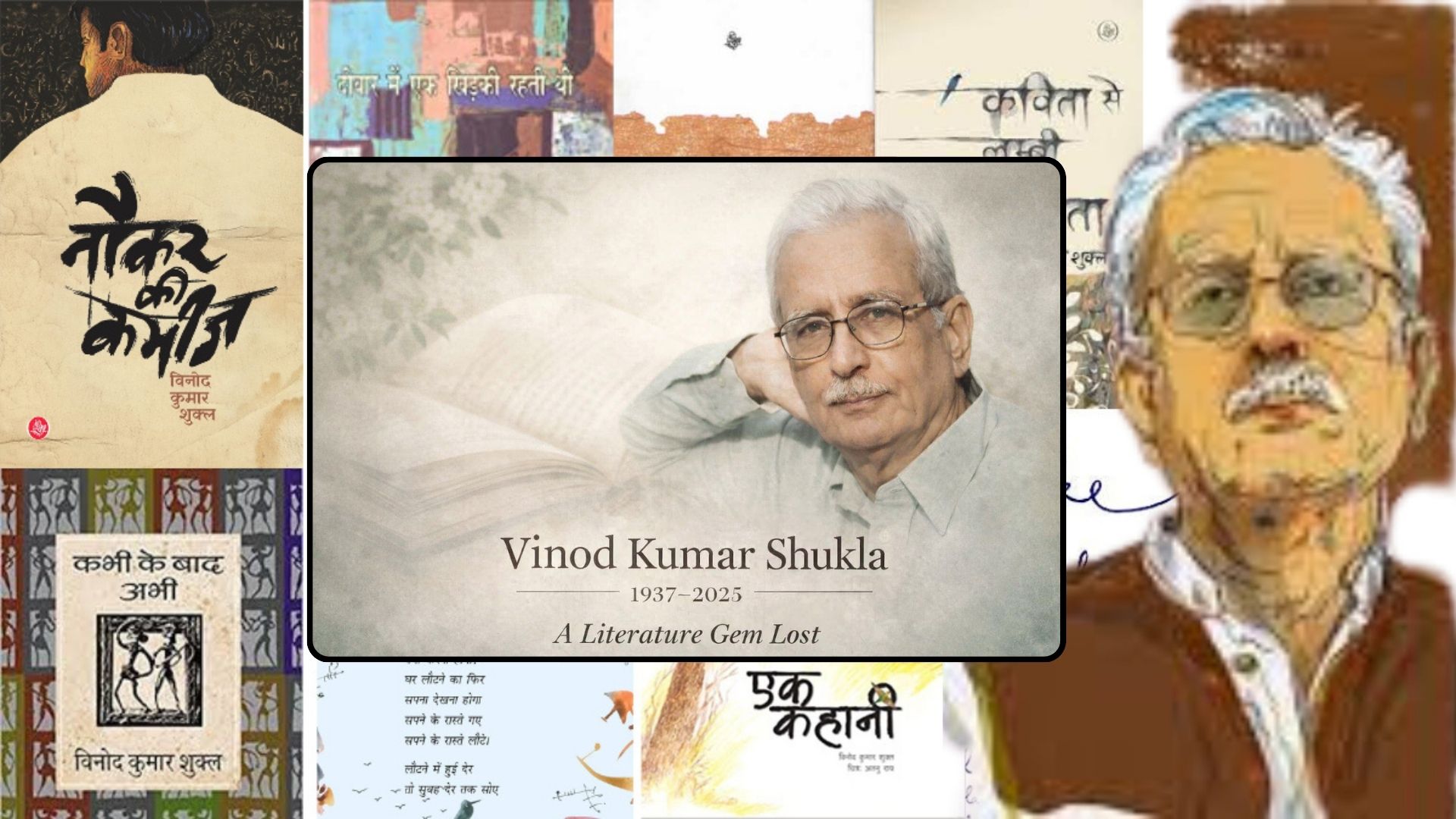

Hindi literature has lost not just a writer, but a rare, luminous gem—one that never tried to dazzle, yet illuminated everything it touched. Vinod Kumar Shukla, the Jnanpith Award–winning literary giant, passed away at the age of 88 at AIIMS Raipur. With his departure, an era of tenderness, restraint, and profound simplicity gently closed its eyes.
He left the world the same way he lived in it—without noise, without spectacle, and with immense grace.
The Man Who Wrote Softly—and Changed Everything
Born on 1 January 1937 in Rajnandgaon, Chhattisgarh, Vinod Kumar Shukla chose a life that stayed far from literary glamour. Teaching was his profession; listening to life was his calling. While many writers chased themes, movements, and manifestos, Shukla quietly sat with the ordinary—rooms, windows, trees, silence—and made them speak.
He showed us that great literature does not shout; it whispers and stays.
A Language That Breathed Like Life Itself
Shukla’s writing was unlike anything Hindi literature had seen before. His words felt as if they were thinking while walking, pausing mid-sentence, unsure yet honest. He turned simplicity into philosophy and everyday moments into poetry.
Reading Vinod Kumar Shukla was like:
- Standing alone in a quiet room
- Watching light fall through a window
- Hearing thoughts you never knew you had
He did not decorate language; he freed it.
Jnanpith Came Late—But Rightfully So
In 2024, he was awarded the 59th Jnanpith Award for his lifelong contribution to literature. He became the first writer from Chhattisgarh and the 12th Hindi author to receive this honour.
The recognition came late, but perhaps that too suited him. Shukla never hurried. His writing believed in waiting, in ripening, in becoming.
Works That Will Continue to Walk With Us
From the unforgettable novel Naukar Ki Kameez to poetry collections like Sab Kuch Hona Bacha Rahega and Aakash Dharti Ko Khatkhatata Hai, his books did not end on the last page. They lingered—like unfinished thoughts, like a familiar silence.
His stories such as Ped Par Kamra and later collections like Ghoda Aur Anya Kahaniyan showed that imagination doesn’t need fantasy; it needs attention.
More Than Awards, A Moral Presence
Yes, he received the Sahitya Akademi Award, the Raza Award, the highest honour of Sahitya Akademi as Mahattar Sadasya, and finally the Jnanpith.
But Vinod Kumar Shukla’s true achievement was something awards cannot measure:
👉 He taught us that kindness can be literary
👉 That hesitation can be artistic
👉 That quietness can be radical
When a Writer Leaves, a Language Feels Emptier
With his passing, Hindi literature feels like a house where one window has closed forever—the kind that let in soft morning light, not harsh brightness.
Yet his words remain.
On shelves.
In classrooms.
In translations.
In readers who learned to love slowness because of him.
A Gentle Goodbye
Vinod Kumar Shukla did not write to impress the world.
He wrote to understand it.
And perhaps that is why, today, as we say goodbye, it feels personal—like losing someone who once sat quietly beside us and understood us without asking.
A literature gem is lost.
But its glow will never fade.

Leave a Comment