

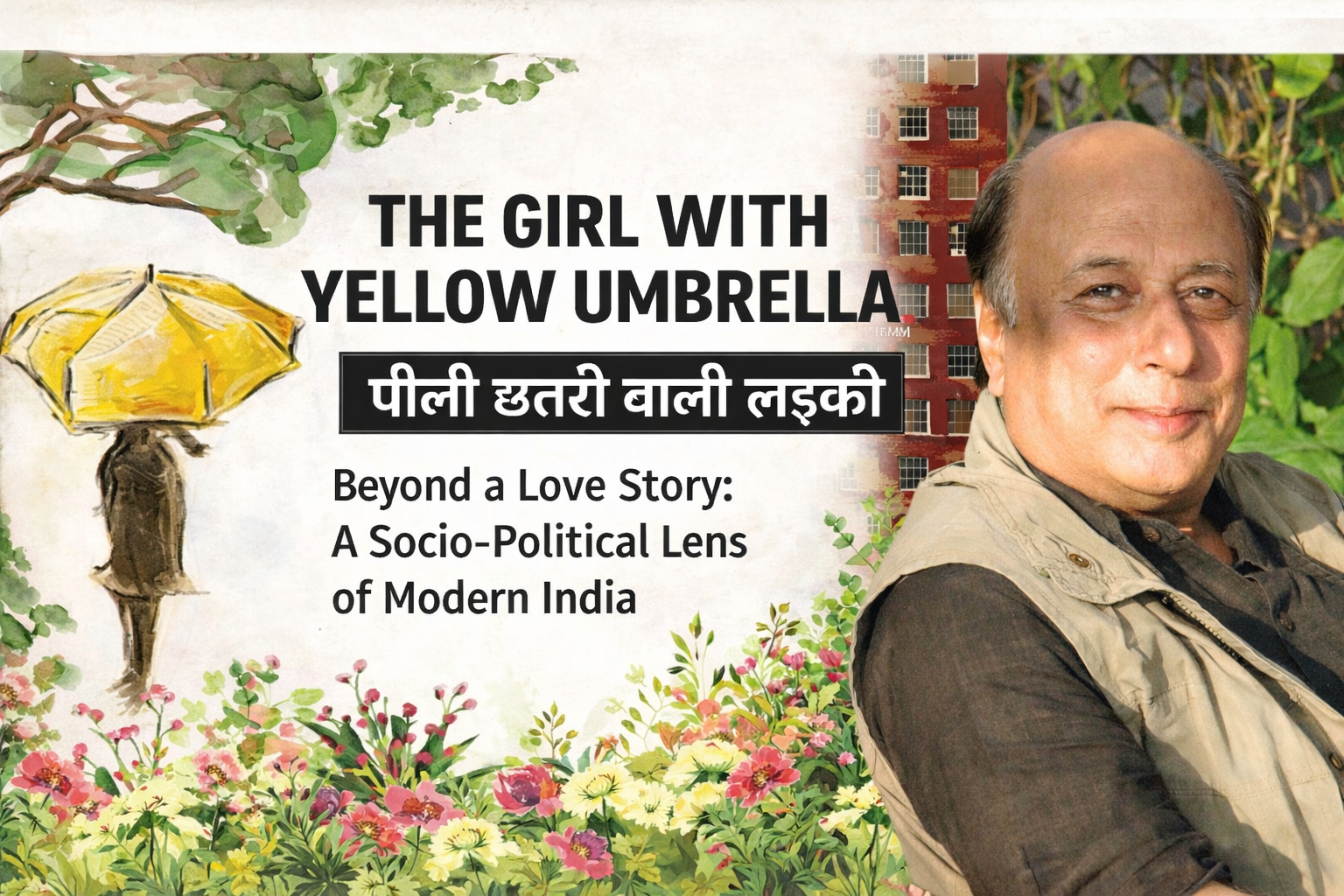

At first glance, Peeli Chhatri Wali Ladki (The Girl with the Yellow Umbrella) sounds like a gentle, romantic love story. The title itself suggests tenderness, nostalgia, and perhaps a campus romance filled with youthful innocence. But as you move deeper into the narrative, it becomes clear that this book is far more than a love story.
Uday Prakash uses love not as the destination, but as a tool—a lens through which he examines the deeper fractures of Indian society, politics, caste hierarchy, education, and the hollow promises of development.
Is it really a love story?
Not quite.
If judged purely as a romance between Rahul and Anjali Joshi, the novel may resemble a familiar university love story. But reducing it to that would be unfair.
Love here is only the surface. Beneath it lies a sharp socio-political critique.
What stays with the reader long after finishing the book is not the romance, but the unsettling questions the author raises through it.
The central characters
- Rahul
A middle-class young man who comes to university dreaming of studying Anthropology and contributing to the upliftment of marginalized tribal communities. He wants to “rewrite history,” to understand power, inequality, and society from the ground up. - Anjali Joshi
The “girl with the yellow umbrella,” daughter of a powerful Brahmin politician. Despite her background, she is gentle, cultured, and emotionally honest. A student of Hindi literature, she becomes the emotional axis around which Rahul’s life begins to turn.
Their relationship leads Rahul to abandon Anthropology and shift to the Hindi department—a symbolic decision that opens the door to the novel’s deeper ideological conflicts.
The university as a political space
In this novel, the university is not just a place of learning. It is a microcosm of Indian society itself.
Uday Prakash exposes:
- Caste dominance in academic spaces
- Brahminical control over Hindi departments
- Intellectual stagnation and favoritism
- The marginalization of students from disadvantaged backgrounds
The depiction of Hindi, Urdu, and Sanskrit departments is especially biting—uncomfortable, satirical, and disturbingly real.
A fierce critique of caste and Brahminism
One of the most striking elements of the book is its direct and unapologetic critique of Brahminism.
Through Rahul’s reflections and conversations, the author questions:
- How one caste has remained “static” at the top for centuries
- How freedom from physical labor enabled control over language, knowledge, and culture
- How myths, rituals, and ideologies were used to dominate collective consciousness
These passages are far more powerful than the romantic plot and form the ideological backbone of the novel.
Voices from the margins: Kashmir, Manipur, and Naxalism
Uday Prakash does not confine his concerns to campus politics alone.
Through characters like Sapam, a Manipuri student, the novel brings forward:
- The alienation of the Northeast
- The selective empathy of mainstream India
- The roots of insurgency, separatism, and armed resistance
The book asks an unsettling question:
Who really belongs to this “new India,” and who is being pushed out of its imagination?
Development, power, and the broker culture
Another sharp layer of the novel is its critique of India’s development model.
The author exposes:
- The unholy alliance between politics and corporate power
- Privatization and disinvestment at the cost of farmers and workers
- A broker-driven system where real power lies outside democratic structures
The satire here is dark, uncomfortable, and painfully close to reality.
Love as transformation, not rebellion
Amid all this, the love between Rahul and Anjali remains deeply human.
- The hesitation of first attraction
- Playful teasing and emotional vulnerability
- The slow, irreversible fall into love
Their relationship dismantles Rahul’s internalized patriarchy and challenges caste-based and consumerist values from within. Love does not become a revolution—but it becomes a quiet betrayal of oppressive norms.
The ending: cinematic, yet symbolic
The novel ends on a note that feels almost cinematic, offering both tragedy and hope. The author chooses one path—but the choice itself is an act of rejection against dominant social expectations.
It is less about closure, and more about refusal.
About the author
Uday Prakash is one of the most fearless voices in contemporary Hindi literature.
- Born in 1952
- Educated in science and Hindi literature
- Former research scholar at Jawaharlal Nehru University
- Sahitya Akademi Award winner for Mohandas
His writing consistently challenges power structures, literary elitism, and social hypocrisy.
Why should you read this book?
If you are looking for more than a conventional love story
If you want to understand caste, power, and politics within Indian academia
If you appreciate literature that provokes discomfort and reflection
Final thoughts
The Girl with the Yellow Umbrella may begin with romance, but it leaves you with questions—about society, history, inequality, and the cost of silence.
The love story fades into the background.
What remains is unease, introspection, and resistance.
And that is precisely why this novel matters.

Leave a Comment