

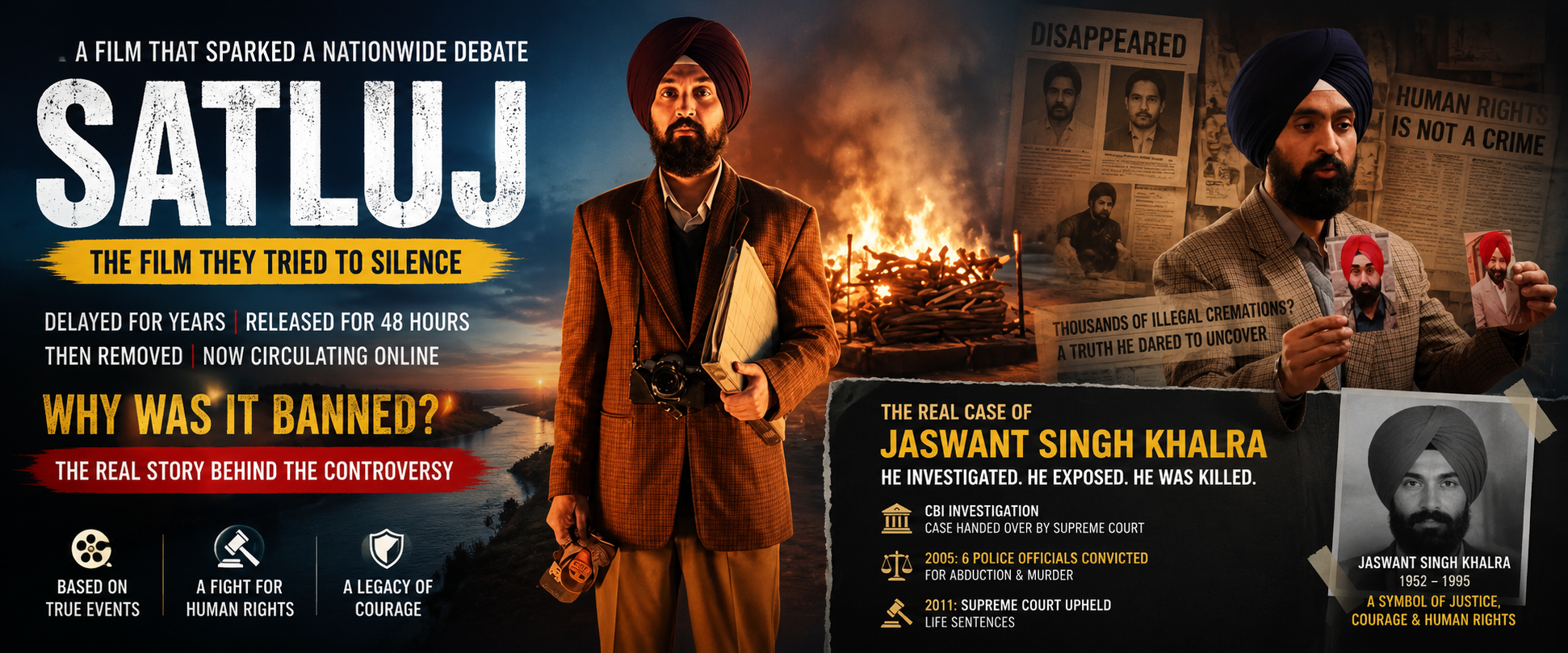

A film that remained stuck for years in censorship debates has suddenly become one of the most talked-about movies on social media—not because of a grand theatrical release, but because people claim it is being shared rapidly through WhatsApp and Facebook.
The film is “Satluj”, starring Diljit Dosanjh, but its story begins long before this title existed.
The real question is not merely “Why is everyone searching for Satluj?”
The bigger question is:
Can banning or removing a film in the digital era actually stop people from watching it?
A Film That Changed Names but Couldn’t Escape Controversy
Before becoming Satluj, the film was known as Punjab ’95. Earlier reports also indicate that it was associated with the working title Ghallughara during development. The movie is directed by Honey Trehan and is based on the life of Jaswant Singh Khalra, the human rights activist who investigated thousands of alleged illegal cremations during Punjab’s insurgency period in the late 1980s and 1990s.
Because the film deals with one of the most politically sensitive chapters in modern Indian history, it reportedly faced extensive scrutiny from the Central Board of Film Certification (CBFC). Reports suggest that numerous cuts were sought before certification, leading to years of delay.
Why Did the Release Take So Long?
According to multiple media reports, the makers and the CBFC remained locked in disagreements over certification for several years.
The concerns reportedly revolved around:
- depiction of police actions during the Punjab insurgency,
- references to real historical events,
- portrayal of government institutions,
- potential impact on public order.
Supporters of the film argued that cinema has the right to depict uncomfortable historical truths.
Those defending stricter scrutiny argued that films based on sensitive events should avoid inflaming tensions.
This disagreement ultimately delayed the film’s public release for years.
The Surprise OTT Release… and Removal Within 48 Hours
Instead of arriving in cinemas with a major promotional campaign, Satluj quietly appeared on ZEE5.
Then something unexpected happened.
Within roughly two days, the film disappeared from the Indian catalogue of the platform.
Different reports have cited different explanations, including certification issues and government concerns related to national security. Public reporting indicates there has not been a single universally accepted explanation from all parties involved.
That removal immediately transformed the film from a delayed release into a national controversy.
Then Came WhatsApp and Facebook
Soon after the OTT removal, social media users began claiming that the complete film was being circulated through WhatsApp groups and Facebook uploads.
Several media organisations have reported widespread circulation of pirated copies after the takedown. However, there is no verified public evidence showing who first leaked the film or how the piracy originated.
That distinction is important.
Fact:
Reports indicate pirated copies circulated online.
Not established:
Who leaked them, whether it was an insider, an external source, or another channel.
Without evidence, assigning responsibility would be speculation.
The “Streisand Effect”: When Suppression Creates Curiosity
Communication researchers often describe a phenomenon called the Streisand Effect.
The idea is simple:
When authorities attempt to suppress information, public curiosity often increases.
Whether or not that happened intentionally here, search interest in Satluj appears to have risen sharply after its removal rather than after its release. Media reports also note that the controversy substantially amplified public discussion.
What Are People Saying on Social Media?
Public reactions appear broadly divided into three groups.
1. Supporters
Many viewers praised Diljit Dosanjh’s restrained performance and argued that difficult chapters of history deserve cinematic representation. Several public figures, including former cricketer Harbhajan Singh, publicly described the film as worth watching.
2. Critics
Others questioned whether films based on politically sensitive events should present contested historical narratives without sufficient context. Some expressed concern about possible social repercussions.
3. Free Speech Debate
A third group focused less on the film itself and more on censorship, arguing that audiences should decide whether to watch such films rather than having access restricted. Community screenings organised by Sikh organisations have further intensified this debate.
Is Watching or Sharing a Leaked Copy Legal?
No.
Even if a film has been removed from an OTT platform, that does not make pirated copies legal.
Uploading, forwarding, or downloading unauthorized copies may violate copyright law and can harm filmmakers and distributors. Reports of widespread circulation should not be interpreted as permission to share the film.
Did the Ban Actually Work?
That depends on how “success” is measured.
If the objective was to limit official distribution, the removal succeeded.
If the objective was to reduce public discussion, the outcome appears more complicated.
The controversy has generated national debate about censorship, artistic freedom, historical memory, and digital piracy. It has also made Satluj one of the most discussed Indian films of recent weeks.
Final Analysis
The story of Satluj is no longer just about one film.
It raises larger questions:
- Should politically sensitive films face greater scrutiny?
- Where should the line between national security and artistic freedom be drawn?
- Can digital bans prevent people from accessing controversial content?
- And in the age of instant messaging, is censorship becoming less effective than ever before?
Whatever one’s opinion on the film itself, one conclusion is difficult to ignore:
In the internet era, controversy often becomes the biggest publicity campaign a movie can receive.
Did You Know?
- The film is based on the life of Jaswant Singh Khalra, whose investigations into alleged secret cremations became one of India’s most significant human rights cases.
- The movie reportedly spent years awaiting clearance before finally reaching audiences under a different title.
- Within days of its brief OTT release, reports emerged of unauthorized circulation across social media platforms, reigniting the debate over piracy versus censorship.
Who Was Jaswant Singh Khalra? The Real Story Behind Satluj
Jaswant Singh Khalra (1952–1995) was a human rights activist from Punjab whose work exposed one of the most controversial chapters of India’s insurgency era. During the 1990s, while serving as General Secretary of the Human Rights Wing of the Shiromani Akali Dal, Khalra investigated records from cremation grounds in Amritsar and Tarn Taran. By comparing official municipal records with missing persons reports, he alleged that thousands of unidentified bodies had been secretly cremated without informing families or following legal procedures. His findings brought national and international attention to allegations of enforced disappearances and extrajudicial killings during Punjab’s militancy period. On 6 September 1995, Khalra was abducted from outside his home in Amritsar. Following intervention by the Supreme Court, the case was handed over to the CBI, whose investigation concluded that he had been abducted and murdered by Punjab Police personnel. In 2005, six police officials were convicted, and after appeals, the Punjab and Haryana High Court enhanced all their sentences to life imprisonment. In 2011, the Supreme Court upheld those life sentences, making the Khalra case one of India’s most significant judicial rulings on custodial killings and enforced disappearances. While the exact number of alleged illegal cremations remains a matter of historical and legal debate, Khalra’s courage in documenting alleged human rights violations has made him a lasting symbol of accountability, justice, and the importance of protecting civil liberties.

Leave a Comment