

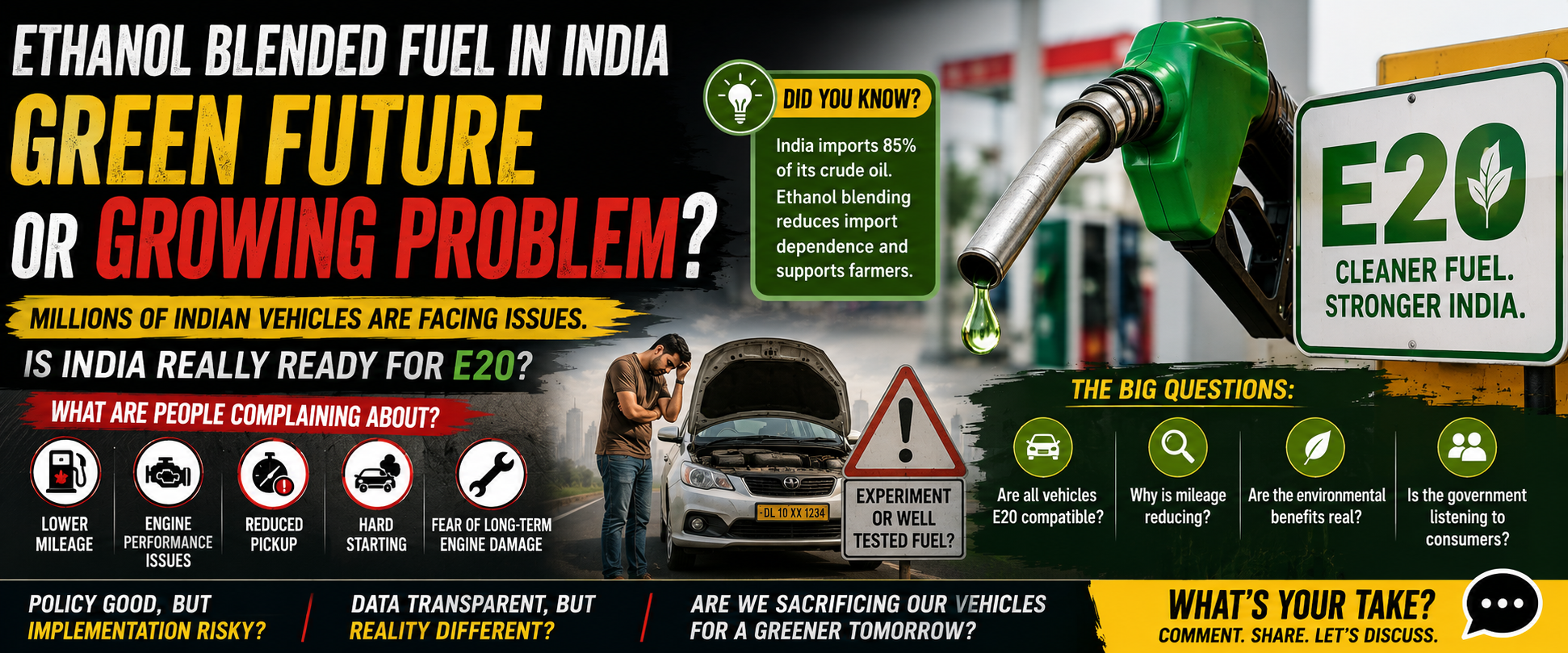

Government’s Vision, Social Media Debate, Environmental Reality & The Big Question — Is India Really Ready?
“A fuel that promises cleaner air, reduced oil imports, and better income for farmers. But is there another side to the story?”
Over the past few years, ethanol-blended petrol (E20) has become one of India’s biggest fuel policy changes. The government calls it a major step toward energy independence and environmental sustainability. Meanwhile, social media is flooded with videos of people claiming reduced mileage, engine problems, and questioning whether Indian vehicles are truly ready for E20.
So…
Who is right?
The answer is not as simple as “yes” or “no.”
Let’s separate facts from emotions.
What Exactly is Ethanol-Blended Fuel?
E20 fuel simply means:
- 80% Petrol
- 20% Ethanol
Ethanol is an alcohol-based biofuel mainly produced in India from:
- Sugarcane
- Molasses
- Damaged food grains
- Maize
- Other agricultural feedstocks
Unlike petrol, ethanol is renewable because it comes from crops instead of crude oil.
🇮🇳 Why is India Pushing Ethanol?
India imports nearly 85% of its crude oil requirement.
That means every rise in global crude oil prices directly affects India’s economy.
The government’s objectives are:
✔ Reduce crude oil imports
✔ Improve energy security
✔ Reduce carbon emissions
✔ Support Indian farmers
✔ Create a domestic biofuel economy
India also achieved its E20 blending target earlier than originally planned and has mandated E20 fuel across the country as part of its long-term energy strategy.
💡 DID YOU KNOW?
Every litre of ethanol blended into petrol means:
- Less imported crude oil
- Lower foreign exchange spending
- More demand for agricultural products
- Additional income opportunities for farmers
That is why ethanol is often called an economic policy as much as an environmental policy.
The Government’s Stand
According to the Ministry of Petroleum & Natural Gas:
- E20 has undergone scientific testing.
- Studies by Indian research institutions found no major engine damage in tested vehicles.
- Performance differences are considered minimal.
- Mileage reduction is expected but generally small because ethanol contains less energy than petrol.
The government believes long-term environmental and economic benefits outweigh these drawbacks.
Then Why Are People Complaining?
Social media tells a very different story.
Many users report:
- Lower mileage
- Rough engine performance
- Hard starting
- Reduced pickup
- Fear of long-term engine wear
Videos showing mechanics blaming ethanol for vehicle issues have received millions of views.
However…
Most of these videos are personal experiences, not scientific studies.
That doesn’t automatically make them false—but they also don’t prove ethanol is the only cause.
Vehicle condition, maintenance, fuel quality, riding habits, and engine tuning all affect performance.
FACT CHECK
❌ Myth:
“E20 destroys every vehicle.”
Reality:
There is no scientific evidence proving that E20 damages every vehicle.
However…
Compatibility depends heavily on:
- Vehicle age
- Fuel system materials
- Engine calibration
- Manufacturer design
Older vehicles may respond differently than newer ones.
Are Indian Vehicles Really Compatible?
This is where the debate becomes serious.
New Vehicles
Most petrol vehicles manufactured from April 2023 onwards were designed to be E20 material-compatible by manufacturers.
These vehicles are expected to handle E20 fuel without major issues.
Older Vehicles
Millions of Indian vehicles on the road were originally designed for:
- E0
- E5
- E10 fuels
Not necessarily E20.
Industry reports estimate that India still has a very large fleet of older two-wheelers and cars that predate E20-compatible designs, raising questions about long-term compatibility as blending levels increase.
That doesn’t automatically mean these vehicles will fail—but it does mean compatibility varies.
Why Mileage Drops
One scientific fact is beyond debate.
Ethanol contains less energy than petrol.
So…
When ethanol percentage increases,
fuel economy naturally decreases slightly.
Many experts estimate:
1–3% reduction under normal conditions for E20-compatible vehicles, although some users report larger real-world reductions depending on vehicle condition and driving style.
Environmental Benefits
This is where ethanol performs well.
Potential advantages include:
✔ Lower greenhouse gas emissions
✔ Cleaner combustion
✔ Reduced dependence on fossil fuels
✔ Renewable fuel source
✔ Supports India’s climate goals
However…
There is another side.
Environmental Concerns Nobody Talks About
Producing ethanol also has environmental costs.
Large-scale ethanol production may require:
- Significant water consumption
- Agricultural land
- Fertilizers
- Transportation
- Industrial processing
If ethanol production increasingly depends on food crops, it could also create pressure on land and food systems.
So ethanol is not a zero-impact fuel—its overall sustainability depends on how it is produced.
The Social Media Controversy
Recently, public debate intensified after remarks made during Supreme Court proceedings were interpreted as describing aspects of the E20 rollout as an “experiment,” leading to political criticism and widespread online discussion. Government representatives later clarified that the reference related to ongoing evaluation of implementation rather than suggesting that the fuel itself was untested.
This controversy reflects a broader issue:
People want transparent answers about:
- Mileage
- Compatibility
- Long-term engine health
- Consumer choice
Is India Ready?
The answer depends on what “ready” means.
From the Government’s perspective
Yes.
Infrastructure has expanded.
Fuel supply has been standardised.
Automobile manufacturers have introduced E20-compatible vehicles.
From the Consumer’s perspective
Not completely.
Many people still own:
- Older motorcycles
- Older scooters
- Older cars
These owners want:
- Clear compatibility information
- Better manufacturer guidance
- Transparent testing data
- Confidence about long-term ownership costs
These concerns deserve evidence-based responses rather than dismissal.
Fact Check Summary
✔ TRUE
India imports most of its crude oil.
✔ TRUE
Ethanol helps reduce crude oil dependence.
✔ TRUE
Ethanol burns cleaner than petrol in many operating conditions.
✔ TRUE
Mileage can decrease because ethanol contains less energy.
PARTLY TRUE
Older vehicles may experience compatibility challenges depending on their design, but this does not mean every older vehicle will suffer engine damage.
FALSE
There is no verified evidence that E20 universally destroys engines.
The Bottom Line
India’s ethanol programme is neither a complete success nor a complete failure.
It is a major transition.
The long-term benefits—energy security, reduced oil imports, farmer support and lower transport emissions—are significant.
At the same time, consumer concerns about mileage, legacy vehicles, and transparency are genuine and should continue to be studied with independent evidence.
The success of ethanol blending will ultimately depend on three things:
- Better vehicle compatibility
- Transparent scientific data
- Keeping consumers informed rather than expecting blind acceptance
Final Thought
A cleaner future requires innovation—but successful innovation also requires public trust. The debate over ethanol in India is not just about fuel; it is about balancing environmental goals, economic priorities, and the everyday experience of millions of vehicle owners.


Leave a Comment