

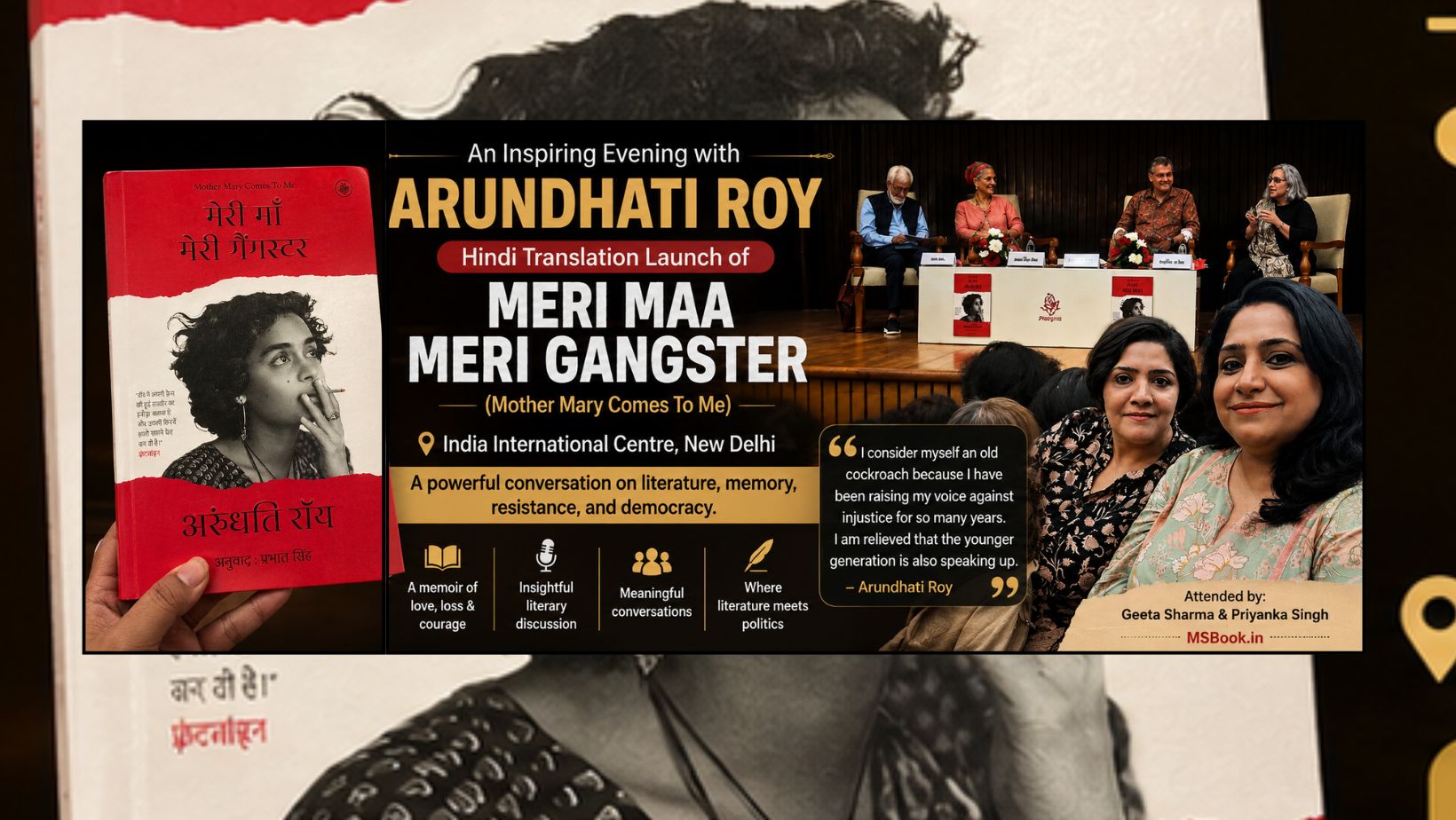

Some book launches are ceremonial. Others become conversations that stay with you long after the applause fades.
The Hindi translation launch of Arundhati Roy’s latest memoir, Meri Maa Meri Gangster at the India International Centre (IIC), New Delhi, belonged firmly to the second category. I attended the event with my MSBook co-founder Priyanka Singh, expecting a literary evening. What unfolded instead was an engaging dialogue on memory, resistance, democracy, protest, and the inseparable relationship between literature and politics.
The auditorium was filled with readers, writers, journalists, students, and admirers who have followed Roy’s journey—from her Booker Prize-winning novel The God of Small Things to her fearless political essays and activism. The atmosphere was warm yet intellectually charged, reflecting the author’s unique ability to blur the boundaries between storytelling and public discourse.
A Memoir That Looks Back Without Looking Away
Meri Maa Meri Gangster is the Hindi translation of Roy’s first memoir, Mother Mary Comes to Me. The book is deeply personal, tracing her relationship with her mother, Mary Roy—a pioneering educationist and women’s rights activist from Kerala.
Rather than presenting a sentimental mother-daughter narrative, Roy explores a relationship filled with love, conflict, admiration, pain, and resilience. She describes Mary Roy as both “my shelter and my storm,” a phrase that captures the emotional complexity of the memoir.
The memoir moves across decades—from Roy’s childhood in Kerala to her life in Delhi, from personal memories to the political realities that shaped her worldview. Like much of her work, the personal gradually opens into the political, suggesting that individual lives cannot be separated from the society in which they unfold.
Literature Meets Politics
During the discussion, Arundhati Roy made it clear that she has never seen writing and activism as two separate identities. She has often rejected the label “writer-activist,” arguing that if literature cannot engage with people’s lives and struggles, it loses much of its purpose.
That philosophy was evident throughout the conversation.
She spoke about contemporary political developments, citizens’ movements, and the importance of dissent in a democracy. One of the most talked-about moments came when she humorously referred to the “Cockroach Janata Party.” The remark was clearly satirical and intended as political commentary rather than a formal political reference.
Roy also recalled public protests at Jantar Mantar, reflecting on decades of activism. With characteristic wit, she remarked that she considers herself “an old cockroach” because she has continued raising her voice against injustice for so many years. The audience responded with laughter, but beneath the humour lay a serious message: persistence matters.
Perhaps the most hopeful moment of the evening came when she said she feels relieved to see younger generations speaking up and questioning authority. Whether one agrees with her politics or not, her appreciation for civic participation and public engagement resonated strongly with many in attendance.
The Courage to Disagree
Arundhati Roy has remained one of India’s most debated public intellectuals. Her books have won prestigious literary awards, while her political positions have frequently attracted criticism and controversy.
Even her memoir became the subject of legal debate because its cover features Roy smoking a beedi. A petition alleged that the image promoted tobacco use. The matter eventually reached the Supreme Court, which dismissed the plea, holding that the photograph did not amount to tobacco advertising. The episode once again illustrated how Roy’s work often generates conversations extending far beyond literature.
Throughout the launch, however, the focus remained on ideas rather than controversy. Roy encouraged readers to think critically, question accepted narratives, and understand how personal histories intersect with larger political realities.
A Memorable Evening at IIC
Beyond the discussion itself, the evening offered an opportunity to reconnect with Delhi’s vibrant literary community. Conversations continued in the corridors long after the formal session ended.
Attending the event with my co-founder Priyanka Singh made the experience even more meaningful. We exchanged thoughts on the discussion, the memoir, and the role books continue to play in shaping public conversations. It was one of those evenings where literature became a bridge—bringing together people from different professions, ideologies, and generations.
Final Thoughts
Whether readers admire Arundhati Roy’s politics or disagree with her positions, one fact remains difficult to ignore: she refuses to separate literature from life.
Meri Maa Meri Gangster is more than a memoir about a mother. It is an exploration of identity, memory, courage, grief, and the forces that shape a writer’s conscience. The launch event reflected these themes beautifully, reminding everyone present that books are not merely objects to be read—they are invitations to think, question, remember, and engage.
As I walked out of the India International Centre that evening with Priyanka Singh, I carried not just a signed copy of a book but also a renewed appreciation for the power of conversations that challenge us to see the world through a different lens.

Leave a Comment