


As of 20 August 2026
What happens when a wildlife sanctuary becomes a global tourism destination?
Who gets to decide how much land around a protected forest should remain protected? What happens when conservation rules affect people who have farmed that land for generations? And where should the line be drawn between tourism that supports local economies and development that changes a fragile ecosystem?
The latest controversy around Kaziranga National Park and Tiger Reserve in Assam brings all these questions together.
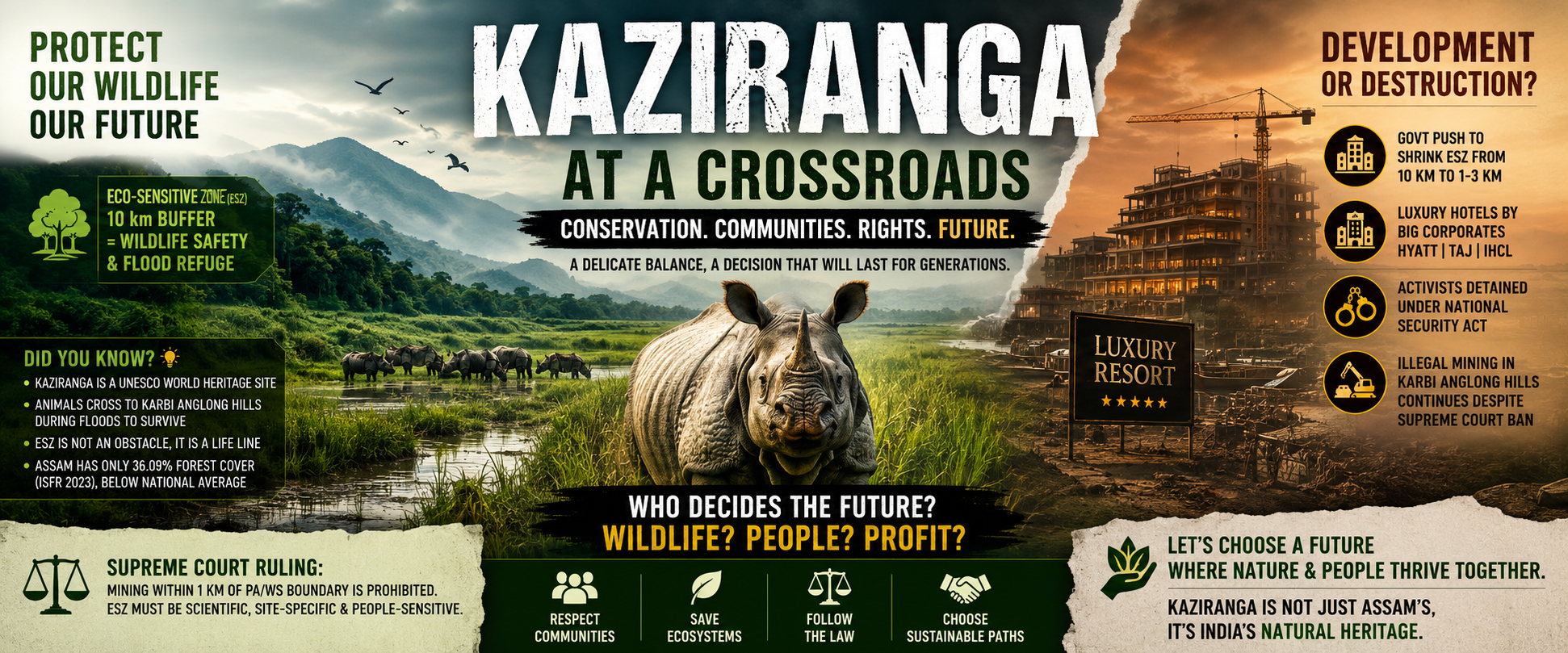
At the centre of the debate are three seemingly simple numbers — 10 km, 3 km and 1 km.
But behind those numbers lies a complicated story involving the Supreme Court, the Assam government, environmentalists, local communities, luxury tourism projects, land rights and the future of one of India’s most important wildlife landscapes.
First, what exactly is an Eco-Sensitive Zone?
An Eco-Sensitive Zone (ESZ) is a regulated area around protected areas such as national parks and wildlife sanctuaries.
It does not mean that every human activity is banned.
Instead, activities are generally classified as prohibited, regulated or permissible depending on their environmental impact.
The idea is simple: a national park cannot function like an island surrounded by unrestricted construction, mining, traffic and pollution.
Animals do not understand administrative boundaries.
A rhinoceros does not stop at a park boundary.
An elephant does not check whether a road falls inside or outside an ESZ.
And during floods, wildlife may need surrounding hills, forests and corridors to survive.
That is why the area around a protected forest can sometimes be as important as the forest itself.
Why is 10 km being discussed?
The often-repeated statement that every national park automatically has a permanent 10-km ESZ is an oversimplification.
The legal history is more complicated.
In the T.N. Godavarman Thirumulpad proceedings, the Supreme Court in June 2022 directed that protected areas should generally have a minimum 1-km ESZ, while a wider already-prescribed or proposed ESZ would continue. For protected areas where no proposal had been submitted, the Court referred to the earlier 10-km framework.
Then came an important clarification in April 2023.
The Supreme Court modified its earlier directions and said that the 1-km direction would not apply where a draft or final ESZ notification had already been issued, or where proposals had been received by the Ministry of Environment, Forest and Climate Change.
It also said environmental and forest clearances must follow the applicable ESZ notifications and the relevant 2011 guidelines.
So the legal question is not simply “10 km versus 1 km.”
It is:
What scientifically appropriate ESZ should be notified for Kaziranga, and how should different land uses be regulated within it?
That distinction matters.
Why does Kaziranga need a special conversation?
Kaziranga is not merely another tourist destination.
It is a UNESCO World Heritage Site, a Tiger Reserve and one of the world’s most important habitats for the greater one-horned rhinoceros.
But Kaziranga also has an unusual ecological problem:
Floods.
The annual floods of the Brahmaputra ecosystem are destructive — but they are also part of the natural functioning of the landscape.
During severe flooding, animals move towards higher ground, including the Karbi Anglong hills south of Kaziranga.
This makes wildlife movement corridors crucial.
The Supreme Court has previously dealt with issues involving Kaziranga’s animal corridors and the landscape south of the park. In November 2024, while considering infrastructure and mining-related matters, the Court recorded steps towards an elevated corridor intended to allow wildlife movement and noted the closure of mining activities along the southern boundary and river catchments.
The message is significant:
A protected area’s ecological security cannot always be measured by looking only at its official boundary.
The luxury hotel question
The second major controversy concerns proposed luxury hospitality projects around Kaziranga.
Local Adivasi farmers have approached the Gauhati High Court challenging the allocation of land for a proposed luxury hotel project at Inglay Pathar.
According to reporting on the litigation, farmers say they have cultivated the land for generations and question the transfer or allocation of land for the project. The state, however, disputes the underlying land-rights position and maintains its own position regarding the land. The High Court has issued notice, meaning the dispute is still a legal matter and should not be presented as a court-confirmed “land grab.”
That last point is important.
In social-media debates, allegations often become “facts” within hours.
But a pending court case means the legal question is not finally settled.
And what about Hyatt and Taj?
This is another area where facts need to be separated from claims.
There has been extensive public discussion about luxury hospitality projects and associations with major hotel groups.
However, Hyatt itself has stated that it had not entered into an agreement to brand or operate the proposed Inglay Pathar/Hathikuli project. That makes it inaccurate to casually describe the project as an officially confirmed “Hyatt hotel” without qualification.
Similarly, references to particular corporate brands should be distinguished from the actual ownership, land allocation, construction contract, branding agreement or operational agreement involved in a specific project.
Corporate involvement is a factual question that should be established project by project.
What did the National Green Tribunal say?
This is another fascinating part of the story.
In February 2025, the National Green Tribunal’s Eastern Zone Bench considered a suo motu case concerning reports about proposed luxury hotels around Kaziranga.
The NGT did not declare the hotels environmentally safe.
It dismissed the case at that stage because the Assam government said its ESZ proposal had been forwarded to the Centre and that no Detailed Project Report for the hotels had yet been submitted. The Tribunal therefore considered the apprehensions premature.
So:
NGT dismissal ≠ judicial approval of the hotels.
That distinction is extremely important.
The people living around Kaziranga
This debate is also about something conservation discussions sometimes overlook:
people.
The area surrounding protected forests is not an empty wilderness.
People farm.
People build houses.
Children need schools.
Families need roads and healthcare.
Small businesses need to survive.
That is precisely why the Supreme Court itself recognised in its 2023 ESZ judgment that large numbers of villages exist inside ESZs across India and that rigid restrictions can affect ordinary activities and basic infrastructure.
Therefore, conservation cannot simply mean:
“No people.”
But development cannot simply mean:
“No restrictions.”
The real challenge is finding the line between the two.
The Pranab Doley controversy
The debate became even more politically sensitive after the arrest of indigenous and land-rights activist Pranab Doley.
Doley was arrested in July 2026 in connection with protests against a proposed luxury hotel project near Kaziranga.
Police alleged offences connected with unlawful assembly, rioting, trespass, intimidation and obstruction of public servants.
On July 29, a sessions court granted him bail. Reporting on the order said the judge noted the prima facie absence of video evidence supporting some of the allegations and that no deadly weapon had been seized during the investigation.
Then came the dramatic twist.
The Assam government invoked the National Security Act (NSA) against Doley, preventing his release despite the bail order.
The government justified the preventive detention on public-order and security grounds. Civil-rights groups and political opponents have criticised the move and questioned whether such a stringent law was appropriate in a land-and-environment protest.
This creates a second debate alongside conservation:
Where does legitimate protest end and a public-order offence begin?
That question ultimately requires evidence, due process and judicial scrutiny — not just political slogans from either side.
The mining paradox
There is another uncomfortable question.
If environmental protection is being debated so intensely around Kaziranga, what about activities that are already known to damage landscapes?
The Supreme Court’s proceedings have repeatedly dealt with mining and quarrying concerns around the Karbi Anglong landscape adjoining Kaziranga.
In November 2024, the Court recorded that authorities had reported closure of mining activities along the southern boundary and river catchments, including action involving numerous stone quarries and crushing units.
The Court has also made the legal position on mining particularly strong.
Its 2023 ESZ judgment directed that mining within a national park or wildlife sanctuary and within one kilometre of its boundary would not be permissible.
This creates an important public-policy question:
Should environmental scrutiny focus only on new hotels, or equally on mining, roads, traffic, quarrying, settlements and other cumulative pressures?
A forest does not experience development project by project.
It experiences the combined impact.
What does India’s wider environmental picture look like?
Kaziranga is part of a much bigger Indian story.
The latest official nationwide benchmark is the India State of Forest Report 2023, published by the Forest Survey of India.
India’s forest and tree cover was estimated at about 8.27 lakh sq km — 25.15% of the country’s geographical area. Compared with 2021, forest and tree cover increased by about 1,446 sq km.
But the national number hides enormous differences between states.
Forest cover as a share of geographical area — ISFR 2023
| State/UT | Forest cover |
|---|---|
| Lakshadweep | 91.33% |
| Mizoram | 85.34% |
| Andaman & Nicobar Islands | 81.62% |
| Arunachal Pradesh | 79.33% |
| Meghalaya | 75.65% |
| Manipur | 74.28% |
| Nagaland | 73.72% |
| Tripura | 72.33% |
| Goa | 60.62% |
| Kerala | 56.77% |
| Assam | 36.09% |
| Odisha | 33.67% |
| Chhattisgarh | 41.21% |
| Madhya Pradesh | 25.00% |
| Maharashtra | 16.53% |
| Punjab | 3.67% |
| Haryana | 3.63% |
The figures above are based on ISFR 2023 data compiled by government sources.
And there is an interesting twist:
Assam is not among India’s highest forest-cover states by percentage.
Its forest cover is about 36.09% of its geographical area.
Yet Assam contains some of India’s most internationally important wildlife landscapes — including Kaziranga and Manas.
This tells us something important:
Forest percentage alone cannot measure ecological importance.
A smaller area can have extraordinary biodiversity, rare species and critical wildlife corridors.
🇮🇳 India’s conservation story is full of contradictions
Consider these numbers.
Madhya Pradesh has India’s largest area of forest cover — about 77,073 sq km.
Arunachal Pradesh follows with about 65,882 sq km.
Chhattisgarh has about 55,812 sq km.
But when we look at the percentage of geographical area under forest, the Northeast dominates the list, with Mizoram, Arunachal Pradesh, Meghalaya, Manipur and Nagaland among the most forested states.
Meanwhile, states such as Punjab and Haryana have forest cover below 4%.
So India’s environmental challenge is not the same everywhere.
A one-size-fits-all conservation formula may therefore be as problematic as a one-size-fits-all development formula.
DID YOU KNOW?
Did you know Kaziranga’s story is not just about rhinoceroses?
Kaziranga is part of a larger landscape where floodplains, grasslands, wetlands, forests and adjoining hills interact.
Protecting the rhino therefore also means protecting the landscape around the rhino.
Did you know floods are not simply an enemy of Kaziranga?
Flooding can be devastating for wildlife and people, but seasonal flooding is also a natural ecological process of the Brahmaputra floodplain.
The challenge is helping wildlife survive extreme flood events without destroying the natural system that sustains the ecosystem.
Did you know the Supreme Court itself moved away from a simplistic “same ESZ everywhere” approach?
Its 2023 judgment recognised that ESZs cannot necessarily have identical boundaries everywhere and allowed the applicable notified/proposed ESZ framework to govern different protected areas.
Did you know eight states/UTs had more than 75% forest cover in ISFR 2023?
They include Mizoram, Arunachal Pradesh, Nagaland, Meghalaya, Manipur and Tripura, along with Lakshadweep and the Andaman & Nicobar Islands.
Did you know “eco-sensitive” does not mean “no development”?
ESZ regulations distinguish between prohibited, regulated and permissible activities.
The objective is regulated development, not automatically eliminating human settlements and livelihoods.
So who is right?
Perhaps the most honest answer is:
Nobody gets to reduce this debate to a slogan.
The Assam government’s argument has a legitimate component:
People living around protected areas cannot be treated as obstacles to conservation.
Villages need infrastructure. Local economies need opportunities. Tourism can generate employment and income.
But conservationists also have a legitimate argument:
Kaziranga’s wildlife does not live according to maps drawn by humans.
Reducing protection around a fragile landscape without strong ecological evidence could increase pressure on corridors, wetlands, forests and flood refuges.
And indigenous communities have a legitimate question too:
If land that has supported families for generations is being repurposed for high-end tourism, were their rights and voices adequately considered?
That question should be answered through transparent land records, legal proceedings and public consultation — not through social-media claims.
The real issue is not “Hotels vs Rhinos”
That is too simple.
The real question is:
Can India build a model of conservation where wildlife, local communities and responsible tourism can coexist?
Imagine a different model.
Instead of asking:
“How much land can we open for development?”
Ask:
“Which areas are ecologically critical, which areas are suitable for carefully regulated development, and which communities have legally recognised rights?”
Then add:
- independent ecological assessment;
- transparent land records;
- wildlife-corridor mapping;
- cumulative-impact assessment;
- genuine consultation with affected communities;
- strict limits on construction density;
- water and waste-management standards;
- traffic and noise controls;
- transparent tourism revenue-sharing;
- and independent monitoring after projects begin.
That would make the debate about evidence, rather than political camps.
And this is bigger than Kaziranga
India is adding highways, airports, hotels, industrial corridors and urban infrastructure at a rapid pace.
At the same time, climate change is increasing the importance of wetlands, forests, mangroves, floodplains and wildlife corridors.
The question India will face repeatedly is:
How much nature can be altered before the economic gains begin to undermine the ecological systems that support the economy itself?
Kaziranga is simply today’s headline.
Tomorrow it could be the Western Ghats.
Or the Himalayas.
Or the Aravallis.
Or a wetland outside a rapidly expanding city.
The lesson should therefore not be “never develop.”
Nor should it be “development at any cost.”
It should be:
Develop where development belongs. Protect what cannot be replaced. And listen to the people who live there.
Because once a road is built, a hill quarried, a corridor blocked or a community displaced, reversing the decision may be far harder than making the right decision in the first place.
FACT CHECK: What we know — and what remains disputed
Established: The Supreme Court has developed a site-specific legal framework for ESZs rather than insisting on one identical width everywhere.
Established: The Supreme Court has prohibited mining within national parks/wildlife sanctuaries and within 1 km of their boundaries under its relevant orders.
Established: The NGT dismissed its 2025 suo motu Kaziranga hotel case at that stage because it considered the apprehensions premature, among other reasons.
Established: Adivasi farmers have taken the land dispute concerning the proposed hospitality project to the Gauhati High Court. The dispute remains subject to judicial consideration.
Established: Pranab Doley was arrested in connection with protests and subsequently detained under the NSA after being granted bail. The legality and appropriateness of that preventive detention remains contested.
Important qualification: Claims describing particular hotel projects as definitively “Hyatt” or “Taj” projects should be checked against the precise corporate agreement. Hyatt has publicly stated that it had not entered an agreement to brand or operate the Inglay Pathar/Hathikuli proposal.
Latest official forest-cover benchmark: ISFR 2023 remains the latest nationwide State of Forest Report available, according to the Forest Survey of India.
Sources
Forest Survey of India; Ministry of Environment, Forest and Climate Change; Supreme Court of India; National Green Tribunal; Gauhati High Court proceedings; Government of Assam; and contemporary reporting from Indian Express, Hindustan Times and other established publications.


Leave a Comment