

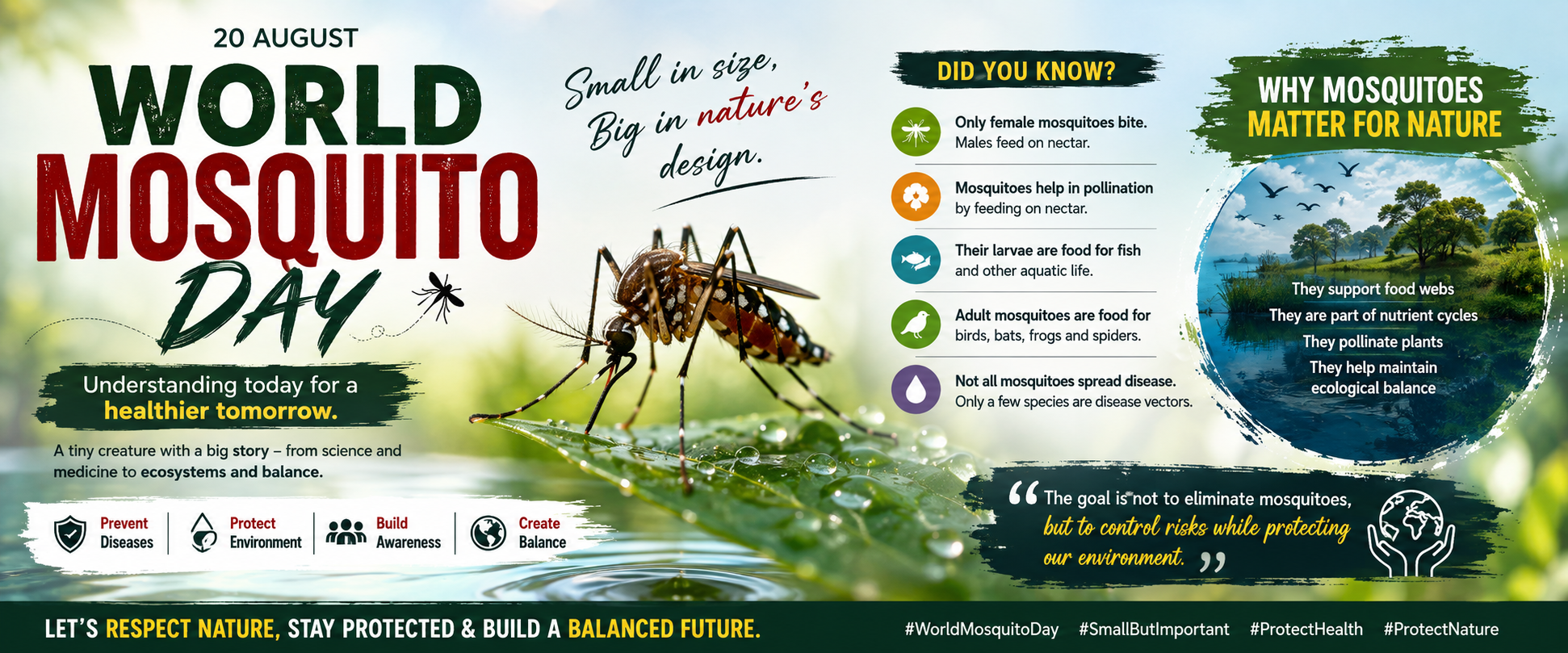

20 August | World Mosquito Day
What if one of the world’s most irritating creatures is also an important part of nature?
Yes, we are talking about the mosquito!
Every year, 20 August is observed as World Mosquito Day to commemorate the 1897 discovery by British physician Sir Ronald Ross that female mosquitoes transmit malaria parasites between humans. The discovery changed the way the world understood and fought malaria.
But there is another side to the mosquito story.
We usually think of mosquitoes as pests—and understandably so. Certain mosquito species can transmit diseases such as malaria, dengue, chikungunya, yellow fever, Zika and Japanese encephalitis. WHO estimates that vector-borne diseases collectively cause more than 700,000 deaths every year, making mosquito control an important public-health priority.
But here’s the surprising question:
WHAT IF MOSQUITOES DISAPPEARED COMPLETELY?
It sounds like great news, right?
Not necessarily.
Mosquitoes are not just disease carriers. They are also part of food webs and ecological systems.
WHY DO MOSQUITOES MATTER TO NATURE?
They are food for other animals
Mosquito larvae live in water and become food for aquatic organisms, including fish and other insects.
Adult mosquitoes can also become food for birds, bats, spiders, frogs and other predators.
Remove one species from an ecosystem and the effects can sometimes travel through the food chain.
Mosquito larvae live in water
Their aquatic larval stage means mosquitoes are connected to freshwater ecosystems. Larvae feed on microorganisms and organic material, becoming part of the nutrient cycle.
SOME MOSQUITOES HELP POLLINATE PLANTS
Here’s a fact many people don’t know:
Not every mosquito is looking for blood.
Male mosquitoes feed on plant nectar, and females also commonly feed on nectar for energy. In doing so, mosquitoes can contribute to pollination.
So the mosquito isn’t simply a “flying needle”!
ONLY FEMALE MOSQUITOES BITE
This is one of the classic mosquito facts.
Male mosquitoes don’t bite humans. Female mosquitoes need nutrients from blood meals for egg production, while both sexes can feed on nectar.
And importantly, not every mosquito species transmits human disease.
DID YOU KNOW?
There are thousands of mosquito species worldwide, but only a relatively small proportion are important vectors of human disease.
Mosquito-borne diseases are strongly influenced by environmental conditions, urbanisation, travel, water management and climate.
Aedes mosquitoes, important vectors of dengue and chikungunya, commonly bite during the daytime.
💧 A tiny amount of standing water can become a breeding site for some mosquito species.
🧬 Mosquitoes are ancient insects that have adapted to remarkably diverse environments.
🦇 Mosquitoes are also part of the diet of several insect-eating animals, including bats and birds.
BUT HERE’S THE BIGGER PROBLEM
The ecological importance of mosquitoes does not mean we should ignore mosquito-borne diseases.
Dengue alone is now a major global health concern. WHO estimates that around 100–400 million dengue infections occur every year, with about half of the world’s population at risk.
Climate and environmental changes can also influence where mosquitoes and the diseases they carry can spread. WHO notes that changes in temperature and rainfall can affect vector-borne disease transmission.
So the real challenge isn’t simply:
“How do we get rid of every mosquito?”
It is:
“How do we control dangerous mosquito populations while understanding and protecting ecosystems?”
That is where science, public health and environmental management come together.
🌏 WORLD MOSQUITO DAY’S BIG LESSON
The mosquito gives us an interesting lesson about nature:
Something can be annoying, dangerous and ecologically important—all at the same time.
Nature rarely works in simple black and white.
The mosquito may be tiny.
But its story connects medicine, climate change, biodiversity, food chains, public health and human behaviour.
So, this World Mosquito Day, don’t just ask:
“Why do mosquitoes exist?”
Ask:
“What can one tiny insect teach us about how complicated our planet really is?”
THE VIRAL TAKE
We spend billions trying to fight mosquitoes.
Nature spends millions of years making them part of the ecosystem.
Maybe the real story isn’t “Mosquito vs Human.”
Maybe it’s “Human Health vs Ecological Balance.”
And that’s a much bigger conversation.


Leave a Comment