

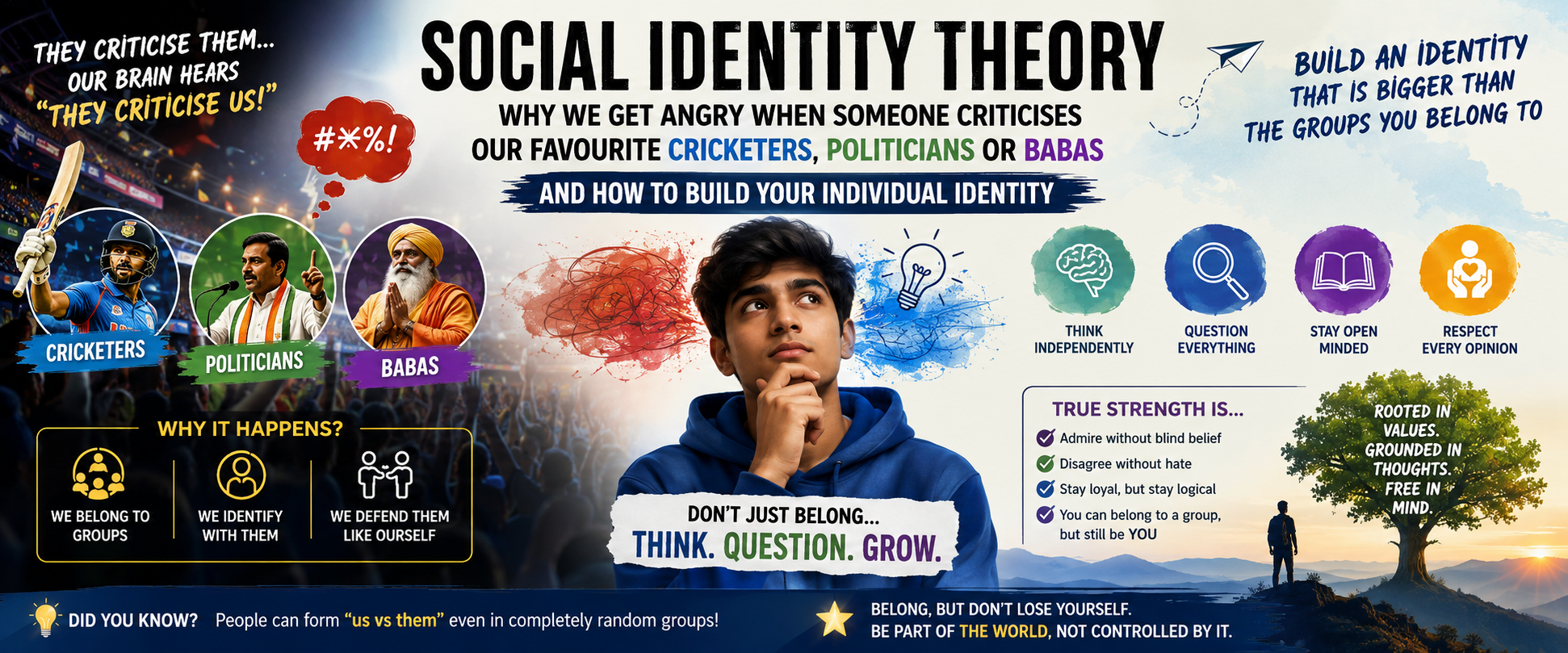

Have you ever seen someone criticise your favourite cricketer and thought, “How dare they!”?
Maybe someone says your favourite politician made a bad decision—and suddenly you feel the need to defend them.
Or someone questions a spiritual leader you deeply admire, and instead of simply disagreeing with their argument, you feel personally attacked.
Here’s the interesting part:
They may have criticised a person. But your brain may have heard it as criticism of YOU.
Welcome to Social Identity Theory—a fascinating idea in psychology that helps explain why our favourite teams, celebrities, political groups, religions, communities and even online fandoms can become part of our identity.
And understanding it can do something even more important:
It can help you build an identity that is bigger than the groups you belong to.
First, what exactly is Social Identity Theory?
Social Identity Theory was developed by psychologists Henri Tajfel and John Turner.
The basic idea is surprisingly simple:
We don’t think of ourselves only as individuals. We also define ourselves through the groups we belong to.
For example:
- “I’m a cricket fan.”
- “I’m a Delhiite.”
- “I’m a science student.”
- “I’m a Swiftie.”
- “I’m a football fan.”
- “I’m from this college.”
- “I support this political ideology.”
- “I follow this spiritual tradition.”
These labels can become part of our social identity.
And once a group becomes part of our identity, we naturally tend to care about its reputation.
That’s where things get interesting.
Why does criticism of a cricketer feel personal?
Imagine you are a huge fan of a particular cricketer.
Someone says:
“I don’t think this player is as good as everyone says.”
Technically, that’s just an opinion about a sportsperson.
But your brain may interpret it differently:
“My favourite player is being attacked.”
And because being a fan has become part of your identity, another thought can quietly appear:
“People are attacking something I identify with.”
That’s why cricket debates can sometimes become far more emotional than the actual subject deserves.
The same psychological mechanism can operate with:
- political leaders
- actors
- musicians
- influencers
- spiritual figures
- universities
- cities
- religions
- social movements
- gaming communities
- online fandoms
DID YOU KNOW?
Psychologists have found that people don’t necessarily need to know each other—or even have a meaningful reason—to form a group identity.
Sometimes, putting people into completely arbitrary groups can be enough to create a sense of “us” and “them.”
This is related to Tajfel’s famous minimal group experiments.
In other words:
Human beings are surprisingly good at creating “we” and “they.”
The “Us vs Them” Brain
Social Identity Theory explains three important psychological processes:
1. Social Categorisation
Our brain loves categories.
It helps us simplify a complicated world.
We automatically classify people:
Us. Them.
Our team. Their team.
Our ideology. Their ideology.
Our celebrity. Their celebrity.
This isn’t necessarily bad. Categorisation is a normal part of human thinking.
The problem begins when categories become more important than individual thinking.
2. Social Identification
After categorising people, we may start identifying ourselves with a particular group.
Instead of saying:
“I support this team.”
It can become:
“We are the best.”
Notice the change?
The team isn’t merely something you enjoy anymore.
It has become part of who you are.
3. Social Comparison
Then comes comparison.
We compare our group with another group.
If our group looks successful, we may feel proud.
If our group loses, we may feel disappointed.
And if someone attacks our group, we may feel the need to defend it.
That’s how a simple cricket match can sometimes feel like a battle between identities.
Your brain doesn’t always ask: “Is this true?”
It can sometimes ask:
“Is this good for my group?”
That’s an important distinction.
Suppose your favourite player performs badly.
You could say:
“He had a poor game today.”
But if your identity is strongly tied to that player, your brain may search for explanations:
- The pitch was bad.
- The umpire was unfair.
- The opposition cheated.
- The team management made mistakes.
- The media is biased.
Sometimes these explanations may actually be correct.
But sometimes we accept them simply because they protect the identity we’ve attached ourselves to.
This is where confirmation bias can join the party.
Confirmation Bias: Your Brain’s Personal Search Engine
Confirmation bias is our tendency to notice and favour information that supports what we already believe.
Imagine you strongly support a political leader.
You may automatically notice:
“Look what they achieved!”
But when someone presents evidence of a mistake, you may become much more critical of the source:
“This media channel is biased.”
Again, that source may genuinely be biased.
But here’s the question:
Would you apply the same level of scepticism if the criticism were aimed at someone you disliked?
That’s the self-check worth making.
FUN FACT: Your Favourite Team Can Become Part of Your Emotional Life
Sports psychologists have long studied how strongly fans identify with teams.
When a team wins, highly identified fans can experience a boost in mood and pride.
When the team loses, the disappointment can feel surprisingly personal.
That’s why you sometimes hear people say:
“We won!”
Even though they didn’t actually play.
They watched.
The players played.
But psychologically, “we” has entered the conversation.
That’s social identity in action.
What about politicians?
This becomes particularly powerful in politics.
A political leader can gradually become more than an individual politician.
For some supporters, that person can symbolise:
- national pride
- social change
- religion
- economic hopes
- cultural values
- identity
- opposition to another group
Now imagine someone criticising that leader.
The criticism may no longer be processed simply as:
“Is this politician’s decision correct or incorrect?”
It can become:
“Are they attacking people like us?”
And once politics becomes an identity battle, facts can struggle to compete with emotions.
And yes, this can happen with spiritual leaders too
Respecting a spiritual teacher, guru or religious figure isn’t inherently a problem.
The important question is:
Can you admire someone without switching off your ability to think critically?
Healthy admiration allows questions.
Unhealthy identification can make questions feel like insults.
There is a huge difference between:
“I respect this person.”
and
“This person can never be wrong.”
The first is admiration.
The second can become blind identification.
When does fandom become unhealthy?
Being passionate isn’t automatically bad.
The warning signs appear when your identity becomes so tightly connected to a group that you:
- cannot tolerate criticism of it
- automatically believe everything your group says
- treat outsiders as enemies
- stop checking evidence
- insult people who disagree
- change your opinions solely to protect the group
- feel personally humiliated when your group loses
- believe your group is always morally superior
At that point, the question isn’t:
“Who is right?”
It becomes:
“How do I protect my identity?”
And that’s a very different psychological game.
The biggest problem: borrowed identity
Here’s the uncomfortable question for the young generation:
How much of your identity is actually yours?
Think about it.
Your favourite celebrity isn’t you.
Your favourite cricketer isn’t you.
Your political leader isn’t you.
Your college isn’t you.
Your religion or community doesn’t represent every aspect of your personality.
Your Instagram fandom isn’t you.
Your favourite football club isn’t you.
These things can be parts of your identity.
But they shouldn’t have to become your entire identity.
Build an individual identity
A strong individual identity means being able to say:
“I belong to groups, but I can also think independently.”
You can love cricket and still criticise your favourite player’s performance.
You can support a political party and disagree with one of its decisions.
You can admire a celebrity and recognise their mistakes.
You can respect a spiritual teacher and still ask questions.
You can love your community without believing everyone outside it is wrong.
That’s not disloyalty.
That’s intellectual independence.
Try the “Remove the Label” Test
Here’s a simple experiment.
When you have a strong opinion, remove the identity label.
Instead of:
“My team is better.”
Ask:
“If I didn’t support this team, what would I think about the evidence?”
Instead of:
“My leader is right.”
Ask:
“If another politician had made exactly the same statement, would I defend it?”
Instead of:
“My favourite celebrity is being targeted.”
Ask:
“Would I consider this criticism reasonable if it were about someone else?”
This tiny mental trick can expose our biases.
DID YOU KNOW? You can disagree without changing teams.
This is perhaps the most important lesson.
You don’t have to leave a group simply because you disagree with one thing.
You don’t have to stop being a cricket fan because your favourite player had a bad match.
You don’t have to abandon your political beliefs because your preferred leader made a mistake.
You don’t have to stop respecting someone because you questioned one of their decisions.
Maturity is the ability to hold two thoughts at the same time:
“I admire this person.”
and
“They can still be wrong.”
That’s not contradiction.
That’s critical thinking.
Social Media Has Made This Even More Powerful
There is another layer young people need to understand.
Social media algorithms are designed to keep users engaged.
If you repeatedly interact with content supporting your beliefs, you may encounter more similar content.
Soon your digital world can start looking like everyone agrees with you.
This can create what is often called an echo chamber.
You see:
People who agree with you.
They share:
Content you already believe.
They criticise:
People you already dislike.
And eventually you may start thinking:
“Everyone knows I’m right.”
But your feed isn’t necessarily a representation of reality.
It is a representation of what the platform thinks will keep you engaged.
The real danger isn’t having strong beliefs
Young people are often told:
“Don’t be emotional.”
That’s not the solution.
Passion is powerful.
Believing in something can motivate people to create, protest, compete, innovate and change society.
The problem isn’t:
having an identity.
The problem is:
letting your identity control your thinking.
A strong identity should give you confidence.
It shouldn’t take away your curiosity.
Your new rule: “People are not their opinions.”
The next time someone disagrees with you, try something unusual.
Don’t immediately ask:
“Which side are you on?”
Ask:
“Why do you think that?”
You might discover something interesting.
Maybe they’re wrong.
Maybe you’re wrong.
Maybe both of you are partly right.
And maybe the issue is far more complicated than your social-media feed suggested.
That’s where real learning begins.
Build an Identity That Doesn’t Need a Fan Club
Imagine introducing yourself without mentioning:
- your favourite celebrity
- your favourite cricketer
- your political preference
- your religion
- your college
- your social-media fandom
What remains?
Your curiosity.
Your kindness.
Your humour.
Your creativity.
Your skills.
Your values.
Your ability to learn.
Your ability to question.
Your ability to stand alone.
That’s your individual identity.
Groups can give us belonging.
But independent thinking gives us freedom.
7 Questions to Ask Yourself
Before getting furious over something you see online, pause and ask:
1. Am I angry because the argument is wrong—or because it attacks “my side”?
2. Would I believe this if someone from the opposite group said it?
3. What evidence could prove me wrong?
4. Am I defending facts—or defending a person?
5. Do I know enough about the subject to have a strong opinion?
6. Am I reacting to the original information or just someone’s edited social-media version?
7. If this group disappeared tomorrow, who would I still be?
That last question is probably the most powerful.
The Bigger Lesson
Social Identity Theory doesn’t tell us that belonging is bad.
Quite the opposite.
Human beings need connection.
We naturally seek communities.
We want to belong.
We want to say:
“These are my people.”
That’s part of being human.
But the healthiest version of identity sounds like this:
“These are my people—but I am still me.”
You can cheer for your team without becoming the team.
You can admire a leader without becoming their follower in every thought.
You can respect a spiritual figure without surrendering your ability to question.
You can belong to a community without losing your individuality.
And you can disagree with someone without turning them into your enemy.
Final Thought
The next time somebody criticises your favourite cricketer, politician, celebrity or spiritual leader, notice your first reaction.
Before replying, take a breath and ask:
“Did they really attack me—or did they simply criticise someone I identify with?”
That tiny pause can create a huge difference.
Because the goal isn’t to become someone who doesn’t care.
The goal is to become someone who cares deeply but thinks independently.
Your favourite team is not your identity.
Your favourite politician is not your identity.
Your favourite celebrity is not your identity.
Your favourite guru is not your identity.
They may be part of your world.
But you are much bigger than the groups you belong to.
And perhaps the strongest identity you can build is this:
“I belong. I care. I question. I think for myself.”
Did You Know?
One of the most powerful signs of intellectual maturity isn’t knowing everything.
It’s being able to say:

Leave a Comment