

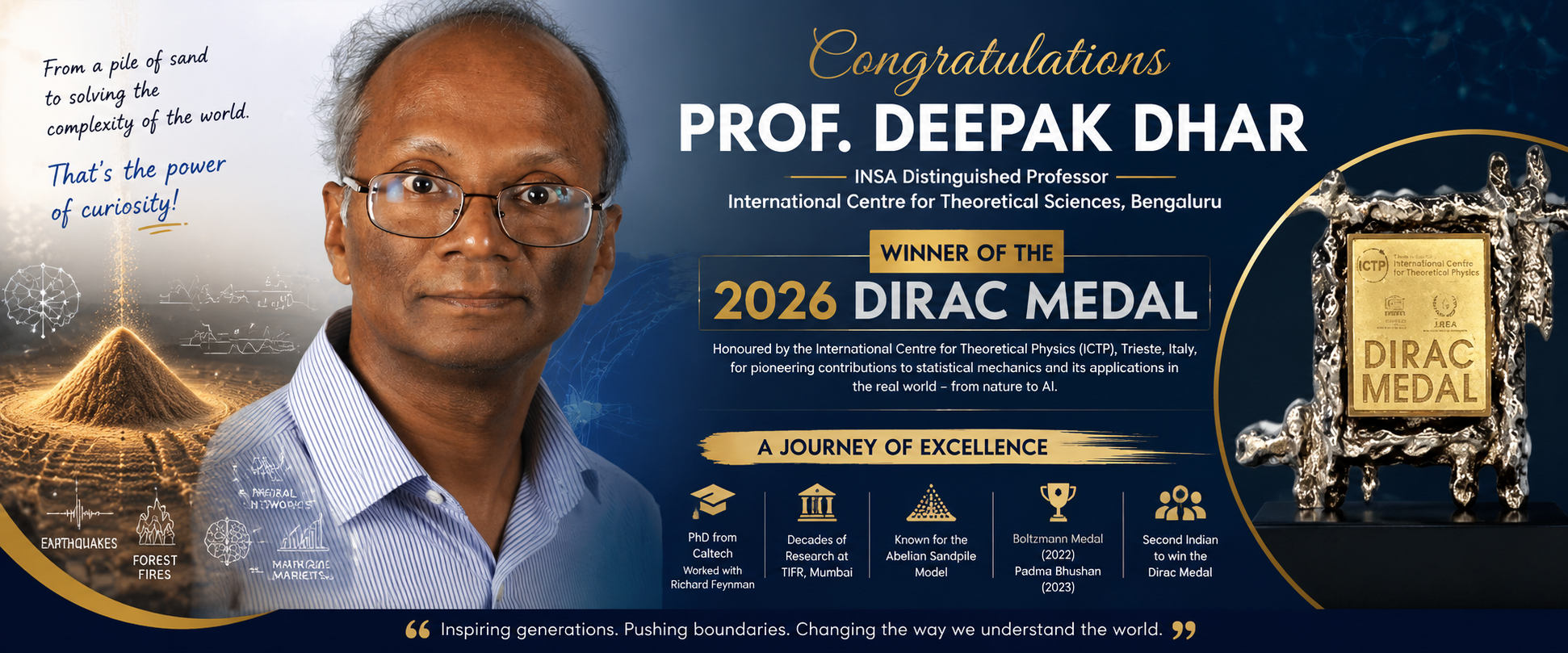

What do a pile of sand, earthquakes, brain activity, forest fires and even financial markets have in common?
Believe it or not, there is a physics model that can help scientists understand all of them.
And the Indian physicist behind one of the most important versions of that model has just received one of the biggest honours in theoretical physics.
Deepak Dhar has been named a winner of the 2026 Dirac Medal, awarded by the International Centre for Theoretical Physics (ICTP), Trieste, Italy.
For young Indians, Dhar’s story is particularly fascinating—not just because of the medal, but because his journey began in Pratapgarh, Uttar Pradesh, and eventually took him to the prestigious California Institute of Technology (Caltech), where he worked under legendary physicist Richard Feynman.
And yes, there is a fascinating story involving a pile of sand.
What exactly is the Dirac Medal?
The Dirac Medal is named after Paul Dirac, one of the giants of modern physics and a Nobel Prize winner.
Instituted in 1985, the medal honours scientists who have made outstanding contributions to theoretical physics.
Past recipients include some of the biggest names in physics, including Stephen Hawking.
But here’s an interesting point:
Did you know?
The Dirac Medal isn’t officially reserved for people who have won the Nobel Prize, Fields Medal or Wolf Prize.
However, several Dirac Medal winners have subsequently gone on to receive these prestigious honours.
So, when Deepak Dhar receives the medal, he joins a very elite club of theoretical physicists whose work has changed how scientists understand the world.
Only the second Indian to win
Dhar is only the second Indian recipient of the Dirac Medal.
The first was renowned string theorist Ashoke Sen, who received it in 2012.
In 2026, Dhar shares the honour with three other eminent physicists:
- Bernard Derrida
- Marc Mézard
- Haim Sompolinsky
The four were recognised for pioneering work in equilibrium statistical mechanics and for extending its ideas into areas including non-equilibrium systems, optimisation, theoretical neuroscience and artificial intelligence.
Sounds complicated?
Let’s make it simple.
What does statistical mechanics actually mean?
Imagine a stadium packed with 50,000 people.
You can’t predict exactly what every individual will do. One person may stand up, another may leave, someone else may start cheering.
But if you look at the crowd as a whole, interesting patterns emerge.
Statistical mechanics works with a similar idea.
Instead of trying to track every individual particle, physicists study huge collections of particles and the patterns that emerge from them.
The surprising part is that complicated microscopic behaviour can sometimes produce surprisingly predictable large-scale behaviour.
And this idea isn’t limited to atoms.
It can also help scientists study systems involving grains, neurons, networks and other complex systems.
The strange story of a pile of sand
Now comes the fun part.
Imagine placing grains of sand one by one on a table.
At first, nothing dramatic happens.
The pile gets bigger.
Add another grain.
Still nothing.
Add another.
Then suddenly…
Avalanche!
A few grains slide down.
Sometimes the avalanche is tiny.
Sometimes it can be much larger.
And here’s the weird bit:
You may not be able to tell exactly which grain will trigger the next avalanche.
This seemingly simple idea became the basis for a major concept in physics called self-organised criticality.
Physicists Per Bak, Chao Tang and Kurt Wiesenfeld proposed that some natural systems can spontaneously organise themselves into a critical state where a tiny disturbance can sometimes create a tiny effect—and sometimes a huge one.
Think of it as nature sitting in a state of:
“Everything is stable… until that one tiny push changes everything.”
Enter Deepak Dhar’s Abelian Sandpile Model
Dhar and his collaborators developed the Abelian sandpile model, turning the sandpile idea into a powerful mathematical framework.
The word “Abelian” might sound intimidating, but the basic idea is surprisingly cool.
Suppose several grains topple and trigger more grains to topple.
You might imagine that the final result would depend on which grain topples first.
But in Dhar’s model, the remarkable property is that the order of these topplings doesn’t change the final stable configuration.
In simple terms:
Different routes → same final destination.
That’s the mathematical beauty behind the “Abelian” property.
From sand to earthquakes—and beyond
Why should anyone care about an imaginary pile of sand?
Because complex systems often behave in surprisingly similar ways.
The ideas associated with sandpile models have been used to explore phenomena such as:
🌋 Earthquakes
🔥 Forest fires
🧠 Neural activity
📈 Financial fluctuations
🌍 Other complex natural and social systems
Of course, the model doesn’t mean that an earthquake is literally just a giant pile of sand.
Rather, it gives scientists a mathematical way of thinking about how small events can sometimes produce disproportionately large consequences.
And that’s a pretty powerful idea.
From Pratapgarh to Caltech
Dhar’s journey is almost as interesting as his scientific work.
Born in 1951 in Pratapgarh, Uttar Pradesh, Dhar grew up in a family where science was encouraged.
His mother wanted him to become an IAS officer.
But his father encouraged his curiosity about science and regularly brought home science magazines, including Understanding Science.
That early exposure helped shape his interest in scientific thinking.
He studied at Allahabad University, followed by IIT Kanpur.
Then came a huge leap.
He travelled to the United States to study at Caltech, one of the world’s leading science and technology institutions.
There, he received a Richard Feynman Fellowship and worked as a teaching assistant under the legendary physicist Richard Feynman.
Dhar completed his PhD in 1978.
Did you know?
Richard Feynman wasn’t just a Nobel Prize-winning physicist. He was also famous for explaining incredibly complicated physics in remarkably simple ways.
Imagine being a young Indian physics student and getting the opportunity to learn directly from him!
Coming back to India
After completing his PhD, Dhar returned to India and joined the Tata Institute of Fundamental Research (TIFR) in Mumbai.
He spent much of his career there.
Later, he spent nearly eight years as a professor at IISER Pune, where he also helped mentor students and contribute to the development of its physics programme.
Since 2024, he has been associated with the International Centre for Theoretical Sciences in Bengaluru, where he is an INSA Distinguished Professor.
A career filled with major honours
The Dirac Medal isn’t Dhar’s first major international recognition.
His list of honours includes:
📌 1991 — Shanti Swarup Bhatnagar Prize
📌 2002 — TWAS Award
📌 2022 — Boltzmann Medal, one of the highest honours in statistical physics
📌 2023 — Padma Bhushan, India’s third-highest civilian honour
📌 2026 — Dirac Medal
Interestingly, Dhar became the first Indian recipient of the Boltzmann Medal in 2022.
He shared that award with John Hopfield, who later became a 2024 Nobel Prize winner in Physics for foundational work related to artificial neural networks.
From sandpiles to Artificial Intelligence?
Here’s perhaps the most surprising connection.
The scientists receiving the 2026 Dirac Medal were recognised not only for traditional statistical mechanics but also for extending its ideas into areas including optimisation, theoretical neuroscience and artificial intelligence.
That tells us something important about modern science:
Physics isn’t confined to physics classrooms anymore.
Ideas originally developed to understand particles and physical systems can influence how scientists think about:
🧠 The brain
🤖 AI
📊 Complex networks
🌍 Natural phenomena
💻 Optimisation problems
This is why theoretical physics remains so relevant in the age of artificial intelligence.
Did You Know? 5 quick facts about Deepak Dhar
1️⃣ He was born in Pratapgarh, Uttar Pradesh
A small-town beginning eventually led to one of the world’s most prestigious physics honours.
2️⃣ His mother wanted him to become an IAS officer
But his father’s encouragement towards science helped set him on another path.
3️⃣ He worked under Richard Feynman
Dhar was a teaching assistant to the legendary physicist at Caltech.
4️⃣ He helped turn a “pile of sand” into serious mathematics
The Abelian sandpile model became an influential framework for studying complex systems.
5️⃣ He is only the second Indian to receive the Dirac Medal
Ashoke Sen was the first Indian recipient, in 2012.
The bigger lesson for Gen Z
Deepak Dhar’s story isn’t really just about physics.
It’s about curiosity.
A science magazine brought home by a father.
A child asking questions.
A student moving from Allahabad to IIT Kanpur.
A scholarship taking him to Caltech.
A young scientist learning from Richard Feynman.
And decades later, recognition from the global scientific community.
The lesson?
You don’t necessarily need to start with a world-changing idea. Sometimes you just need to stay curious about something as ordinary as a pile of sand.
Because science often begins with a simple question:
“Why does this happen?”
And sometimes, following that question for decades can lead you all the way to the Dirac Medal.
Deepak Dhar’s journey is a reminder to India’s younger generation that world-class science isn’t something that happens only somewhere else. It can begin in a classroom, a library—or even a small town in Uttar Pradesh.

Leave a Comment