

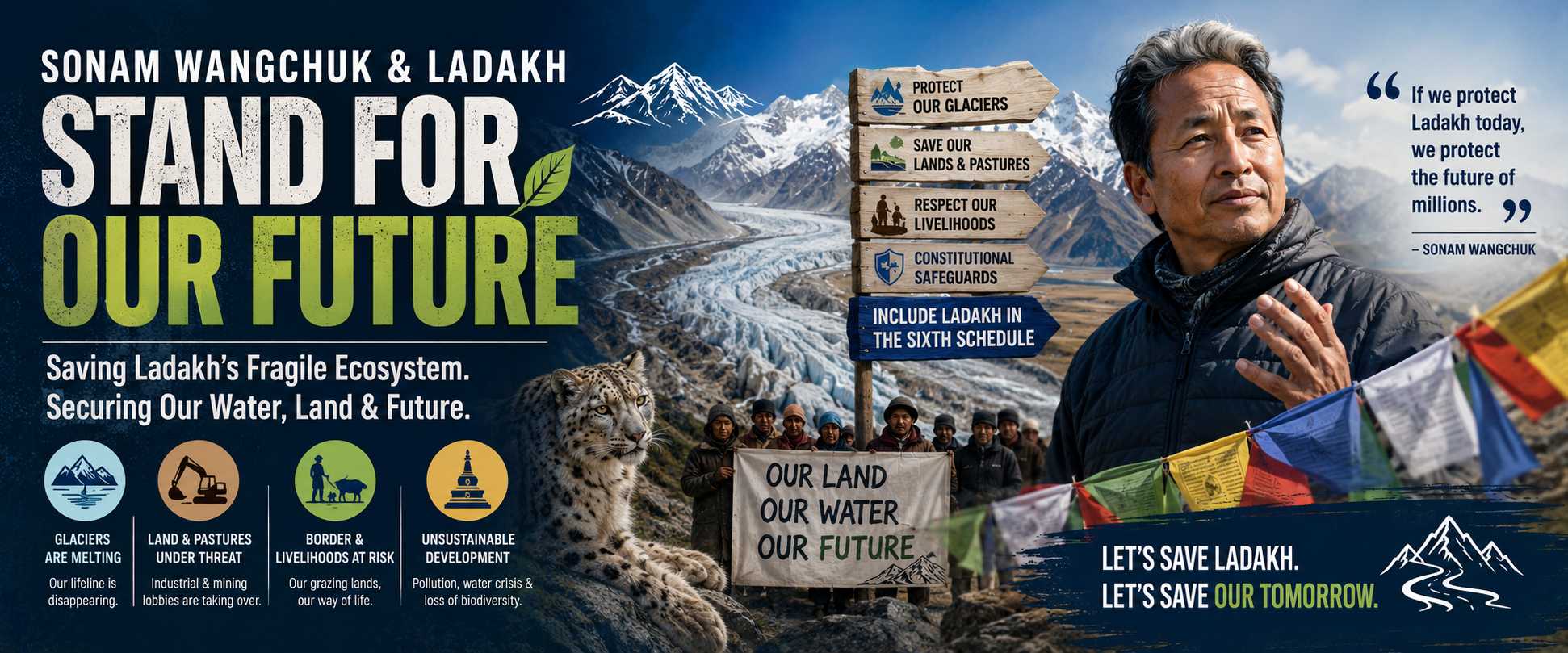

“If the glaciers of the Himalayas disappear, the crisis won’t remain in Ladakh—it will reach every river, farm, and city that depends on them.” — This warning has become the central message of educator, innovator, and environmental activist Sonam Wangchuk.
For many Indians, Wangchuk is the engineer and education reformer who inspired the character of Rancho in the blockbuster film 3 Idiots. But today, he finds himself at the center of a much larger battle—one that concerns climate change, ecological survival, indigenous rights, and the future of Ladakh itself.
The Silent Crisis in India’s Cold Desert
Ladakh is often celebrated for its breathtaking landscapes, crystal-clear skies, and snow-capped mountains. Yet beneath this beauty lies one of the world’s most fragile ecosystems.
Unlike the lush Himalayas of Himachal Pradesh or Uttarakhand, Ladakh is a cold desert. Rainfall is scarce, agriculture depends almost entirely on glacial meltwater, and local communities have survived for centuries through a delicate balance between nature and human activity.
Today, that balance is under threat.
Scientists across the Himalayan region have documented alarming rates of glacier retreat. Rising temperatures, erratic snowfall, and changing weather patterns are shrinking the frozen reservoirs that sustain rivers and communities across South Asia.
The stakes are enormous. The Himalayan glaciers are often called the “Third Pole” because they contain the largest store of ice outside the Arctic and Antarctica. These glaciers feed major river systems that support nearly two billion people across Asia.
For Ladakh, the consequences are immediate: less water for farming, increased drought risk, and growing uncertainty for future generations.
Why Sonam Wangchuk Is Sounding the Alarm
Over the past few years, Wangchuk has transformed from an education innovator into one of India’s most prominent climate voices.
Through public speeches, climate fasts, awareness campaigns, and long marches, he has repeatedly warned that Ladakh is approaching an ecological tipping point.
His argument is simple:
Development is necessary, but development without ecological safeguards could permanently damage one of the planet’s most sensitive mountain environments.
According to Wangchuk and many Ladakhi civil society groups, the challenge is not merely climate change. It is the combination of climate stress and unchecked commercial expansion that could push the region beyond recovery.
The Battle Over Land and Resources
One of the biggest concerns raised by local communities involves large-scale industrial and mining interests.
Ladakh’s vast open landscapes may appear empty to outsiders, but they are essential grazing grounds for pastoral communities who have depended on them for generations.
Activists argue that uncontrolled industrial projects could:
- Reduce available pastureland.
- Disrupt traditional livelihoods.
- Fragment wildlife habitats.
- Increase pressure on scarce water resources.
- Accelerate ecological degradation.
Environmentalists fear that once fragile mountain ecosystems are disturbed, restoration becomes extraordinarily difficult.
For local residents, the issue is not opposition to development itself but ensuring that development respects ecological limits and community rights.
The Border Dimension
Another sensitive issue concerns areas along the Line of Actual Control (LAC).
Wangchuk has repeatedly highlighted concerns raised by nomadic herders and border communities who claim they are gradually losing access to traditional grazing lands.
For these communities, the issue is not only geopolitical—it is also economic and environmental.
When grazing routes become restricted, pressure increases on remaining pastureland, creating further stress on an already fragile ecosystem.
This intersection of ecology, livelihood, and national security makes Ladakh’s situation uniquely complex.
Tourism: Blessing or Burden?
Tourism has become one of Ladakh’s most important economic sectors.
Every year, hundreds of thousands of visitors arrive to experience its mountains, monasteries, lakes, and adventure sports.
Tourism creates jobs and income, but it also creates new challenges:
- Increased waste generation.
- Rising demand for water.
- Pressure on local infrastructure.
- Expansion of hotels and commercial construction.
- Disturbance to wildlife habitats.
Environmental experts warn that Ladakh cannot simply copy the urbanization model of larger Indian cities.
Unlike cities connected to major rivers and extensive water networks, Ladakh survives on extremely limited resources.
A rapid increase in population density and construction could strain these resources beyond sustainable limits.
The Sixth Schedule Demand
At the heart of the movement lies a constitutional demand: inclusion of Ladakh under the Sixth Schedule of the Indian Constitution.
The Sixth Schedule currently provides special protections and autonomous governance mechanisms for certain tribal areas in northeastern India.
Supporters believe similar safeguards would allow Ladakh’s indigenous communities greater control over:
- Land use policies.
- Forest management.
- Water resources.
- Local development planning.
- Cultural preservation.
Advocates argue that such protections would help ensure that decisions affecting Ladakh’s environment are made with local participation rather than being driven solely by external commercial interests.
Critics, however, argue that governance reforms must be balanced with national development priorities and investment needs.
The debate therefore extends beyond Ladakh, raising broader questions about how India should balance economic growth, strategic interests, environmental protection, and indigenous rights.
Climate Fasts and the March for Awareness
To draw national attention to these issues, Wangchuk has undertaken several high-profile climate fasts and public campaigns.
His methods echo traditions of non-violent environmental activism, using symbolic actions to highlight what he sees as an urgent ecological emergency.
These campaigns have attracted support from environmentalists, scientists, students, and citizens concerned about climate change.
Social media has amplified the movement, transforming what was once a regional issue into a national conversation about sustainability and environmental governance.
Why Ladakh Matters to All Indians
It is easy to think of Ladakh as a distant frontier. But the challenges facing Ladakh are connected to larger questions confronting India and the world.
Can fragile ecosystems survive the pressures of rapid development?
How should indigenous communities participate in decisions about their land?
Can economic growth be pursued without sacrificing ecological security?
And perhaps most importantly: what happens when climate change reaches a point where adaptation is no longer enough?
The answers to these questions will not be found in Ladakh alone.
Yet Ladakh may become one of the first places where humanity is forced to confront them.
The Road Ahead
The debate surrounding Ladakh is often framed as a conflict between development and conservation. In reality, the challenge is finding a path that achieves both.
Few people argue against infrastructure, jobs, or economic opportunity. The real question is whether growth can occur without damaging the very natural systems that sustain life in the region.
Sonam Wangchuk’s campaign has succeeded in bringing that question to the national stage.
Whether one agrees with every aspect of his movement or not, his message is difficult to ignore:
The glaciers, rivers, pastures, and biodiversity of Ladakh are not merely local assets. They are part of a larger ecological system that supports millions of lives.
And once lost, they may never return.
As the climate crisis accelerates, Ladakh’s struggle may ultimately become a warning—and a lesson—for the entire world.


Leave a Comment