

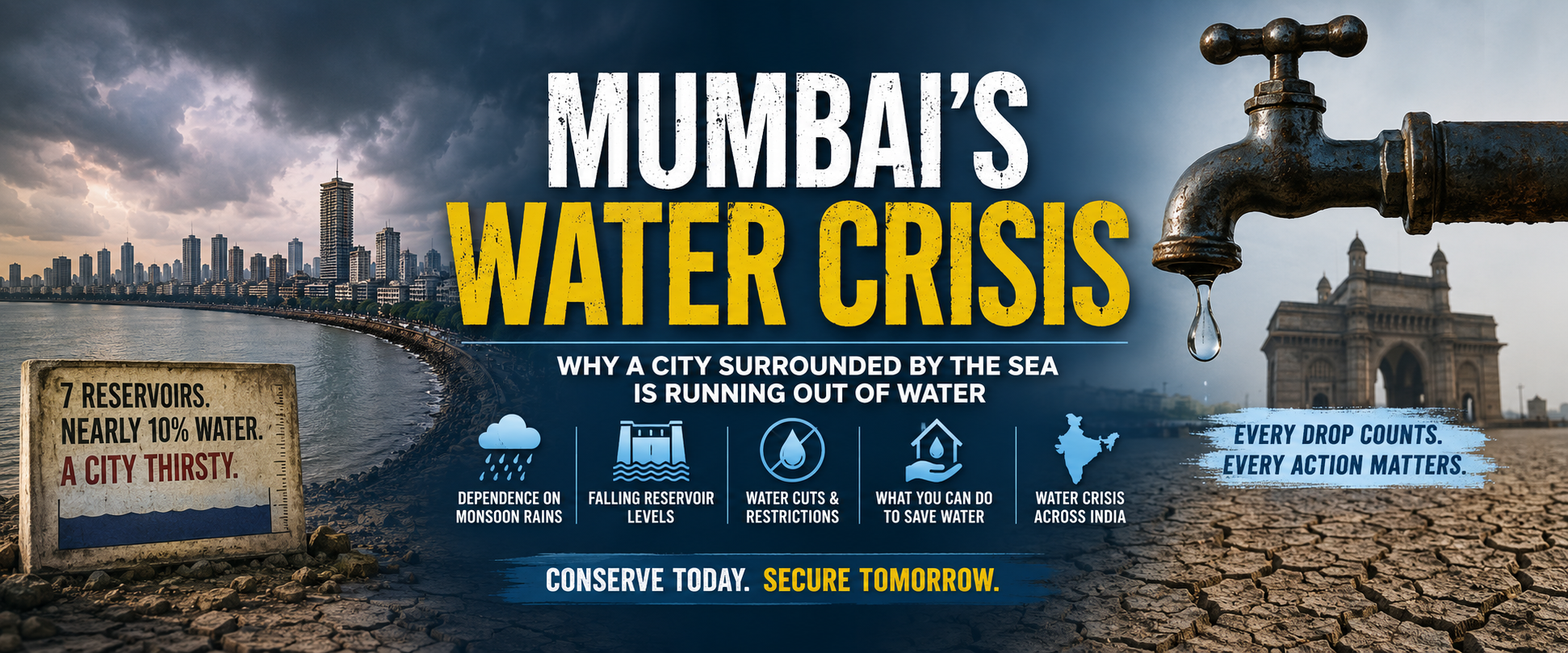

Mumbai, India’s financial capital and home to more than 20 million people, is once again facing a severe water crisis. The Brihanmumbai Municipal Corporation (BMC) has imposed water restrictions after reservoir levels dropped to critically low levels due to delayed and below-normal monsoon rains. In June 2026, the city’s seven reservoirs reportedly fell to nearly 10% of their storage capacity, leaving only a few weeks of water supply if rains failed to arrive on time.
The situation raises a question that many people ask every year:
How can a city surrounded by the Arabian Sea run short of water?
Mumbai’s Dependence on Monsoon Rainfall
Mumbai receives almost all of its drinking water from seven reservoirs:
- Bhatsa
- Upper Vaitarna
- Middle Vaitarna
- Modak Sagar
- Tansa
- Vihar
- Tulsi
These reservoirs collect rainwater during the monsoon season and supply water throughout the year.
Unlike many inland cities, Mumbai cannot rely heavily on groundwater. Excessive groundwater extraction in a coastal city can cause seawater to seep into underground aquifers, making the water salty and unusable. As a result, Mumbai remains highly dependent on annual monsoon rainfall.
When the monsoon arrives late or delivers less rainfall than expected, reservoir levels decline rapidly and authorities are forced to impose restrictions.
The 2026 Water Crisis
This year’s crisis is particularly severe because Maharashtra experienced significantly below-average rainfall during the early monsoon period. Mumbai recorded one of its driest Junes in more than a decade, forcing authorities to take emergency measures.
The BMC has:
- Imposed city-wide water cuts.
- Reduced supply to industrial and commercial establishments.
- Suspended water supply to construction sites.
- Stopped water supply to swimming pools.
- Increased monitoring of water wastage.
While these measures may help stretch available supplies, they highlight a deeper structural problem: Mumbai’s growing population continues to increase water demand while climate change is making rainfall patterns increasingly unpredictable.
Why Being Next to the Sea Doesn’t Solve the Problem
Many people assume Mumbai could simply convert seawater into drinking water.
Technically, it can.
The process is called desalination, where salt is removed from seawater. Countries such as Israel, Saudi Arabia, and the United Arab Emirates rely heavily on desalination.
However, desalination has challenges:
1. High Energy Costs
Desalination plants consume enormous amounts of electricity, making water more expensive.
2. Environmental Concerns
The process produces highly concentrated salt waste, which can harm marine ecosystems if not managed carefully.
3. Infrastructure Costs
Building and maintaining large-scale desalination plants requires massive investment and long-term planning.
Experts increasingly argue that desalination should be part of the solution, but not the only solution. Rainwater harvesting, wastewater recycling, leak reduction, and improved storage systems are equally important.
Mumbai Is Not Alone
Mumbai’s water crisis is part of a larger national challenge.
Bengaluru: From Garden City to Tanker City
Bengaluru has become one of India’s most water-stressed cities.
Rapid urbanization, shrinking lakes, and over-dependence on groundwater have forced many residents to rely on private water tankers. Some households spend thousands of rupees every month simply to secure water. The city depends heavily on the Cauvery River, while groundwater levels continue to decline.
Delhi: A Capital Struggling for Water
Despite being located near the Yamuna River, Delhi faces recurring water shortages due to population pressure, pollution, infrastructure losses, and unequal distribution. In several areas, residents depend on water tankers and often wait days for supply.
Hyderabad: India’s Groundwater Warning Sign
Recent groundwater assessments indicate that Hyderabad is among the most stressed metropolitan regions in India. Rapid expansion, excessive groundwater extraction, and inadequate recharge systems have pushed the city toward a dangerous water future.
Chennai: Lessons from “Day Zero”
Although Chennai has improved its water management since its famous 2019 crisis, the city remains vulnerable. It depends heavily on monsoon rainfall, reservoirs, groundwater, and desalination plants. A failed monsoon can quickly bring the city back into water stress.
Climate Change Is Making Things Worse
Scientists warn that climate change is altering India’s rainfall patterns.
Instead of steady seasonal rainfall, cities increasingly experience:
- Longer dry periods
- Delayed monsoons
- Intense cloudbursts
- Flash floods followed by drought conditions
Ironically, cities may experience devastating floods during one part of the year and severe water shortages during another.
Mumbai itself illustrates this contradiction perfectly. The city often receives some of the heaviest rainfall in the world during monsoon months, yet struggles with water scarcity before and after the rainy season.
What Can Citizens Do?
While governments must lead large-scale reforms, citizens can help reduce pressure on urban water systems.
At Home
- Fix leaking taps immediately.
- Use buckets instead of long showers.
- Reuse RO wastewater for cleaning.
- Install low-flow fixtures.
- Harvest rainwater wherever possible.
In Housing Societies
- Promote wastewater recycling.
- Monitor leakage in internal pipelines.
- Install smart water meters.
- Encourage rooftop rainwater harvesting.
At Community Level
- Protect lakes and wetlands.
- Support groundwater recharge projects.
- Demand better water infrastructure from local authorities.
The Bigger Question
Mumbai’s crisis is not merely about a delayed monsoon. It reflects a broader challenge facing urban India: cities are growing faster than their water systems can adapt.
The future of India’s megacities will depend not only on how much rain falls from the sky but also on how efficiently every drop is stored, distributed, recycled, and conserved.
As climate uncertainty grows, water security may become one of the defining challenges of India’s urban future.
The real question is no longer whether another water crisis will occur. The question is whether our cities will be prepared when it does.


Leave a Comment