


From Kitchen Waste to Global Innovation
Imagine this: You’re drinking a glass of water that looks crystal clear. But hidden inside could be thousands of tiny plastic particles so small that you can’t even see them.
Sounds like a sci-fi problem, right?
Well, three Indian teenagers decided not to wait for adults to fix it.
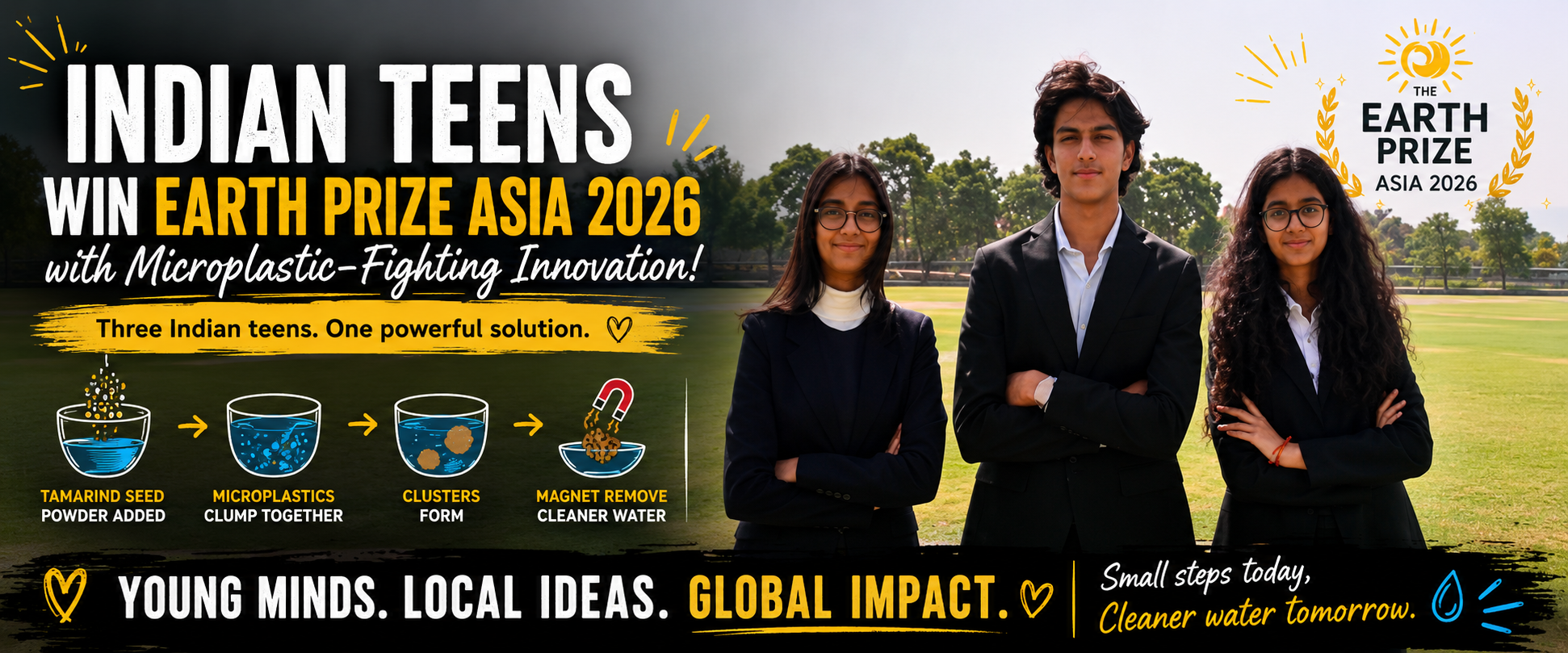
Meet Vivaan Chhawchharia, Ariana Agarwal, and Avyana Mehta — three 16-year-olds who just became the first Indian team to win the prestigious The Earth Prize 2026. Their invention, called Plas-Stick, uses something most of us throw away without a second thought: tamarind seeds.
And honestly? That’s the coolest part.
The Problem Nobody Can See
Microplastics are tiny plastic particles smaller than 5 millimeters. They’re found almost everywhere — oceans, rivers, food, air, and even drinking water.
The scary part is that they’re practically invisible.
Scientists are still studying their long-term health effects, but microplastics have already become one of the fastest-growing environmental concerns worldwide.
While studying environmental science and visiting rural communities, the three students noticed a major issue: many families stored drinking water in large plastic containers without access to advanced filtration systems.
Watching children drink from these containers sparked a question:
What if there was a cheap, simple way to remove microplastics from water without electricity?
Enter: Plas-Stick
Instead of building an expensive machine, the trio looked for something local, affordable, and sustainable.
Their answer?
Waste tamarind seeds.
After months of testing, experimenting, failing, and trying again, they developed a biodegradable powder made from discarded tamarind seed waste.
Here’s how it works:
Step 1: Add the Powder
The Plas-Stick powder is mixed into contaminated water.
Step 2: Plastic Meets Magnetism
The powder attracts suspended microplastic particles and causes them to stick together.
Step 3: Tiny Plastics Become Visible
The microplastics clump into larger, visible clusters.
Step 4: Magnet Time
A simple handheld magnet pulls out the clusters, leaving cleaner water behind.
No electricity.
No expensive filters.
No complicated machinery.
Just science, creativity, and tamarind seeds.
The IIT Guwahati Connection
One of the most inspiring parts of the story is how the students got help.
Instead of waiting for opportunities, they reportedly cold-emailed scientists and researchers for guidance. Their efforts eventually led to collaboration and support from researchers connected with Indian Institute of Technology Guwahati, helping validate and strengthen the science behind Plas-Stick.
A reminder that sometimes sending that one email can change everything.
More Than a Science Fair Project
This isn’t just a cool experiment.
The team specifically designed Plas-Stick for communities that don’t have reliable access to electricity or advanced water treatment systems.
Globally, more than 2.2 billion people lack safely managed drinking water infrastructure. Solutions that are low-cost, portable, and easy to use could make a huge difference.
The project has already reached over 8,000 students and teachers through workshops and demonstrations.
Winning the Earth Prize
The Earth Prize is one of the world’s largest environmental competitions for young people aged 13 to 19.
After first winning the Asia regional category and receiving a $12,500 grant to scale their innovation, the Indian trio went on to become the Global Winners of The Earth Prize 2026 — a first for India. Around 23,000 people participated in the voting process that selected the global winner.
Not bad for a project that started with a simple question about clean drinking water.
Why Gen Z Should Care
There’s a stereotype that young people spend all day scrolling, gaming, or making memes.
Then stories like this happen.
Three teenagers looked at a global problem, used local resources, emailed experts, partnered with researchers, and built a solution with the potential to improve lives.
That’s not just innovation.
That’s Gen Z energy at its best.
The next breakthrough might not come from a billion-dollar company or a massive laboratory.
It might come from a classroom.
Or from a teenager staring at a glass of water and asking:
“There has to be a better way.”
The Bottom Line
Plas-Stick proves that solving global problems doesn’t always require futuristic technology. Sometimes it starts with curiosity, persistence, and a handful of tamarind seeds.
And if three 16-year-olds can take on microplastic pollution, maybe the future isn’t as doomed as the internet keeps telling us.

Leave a Comment