

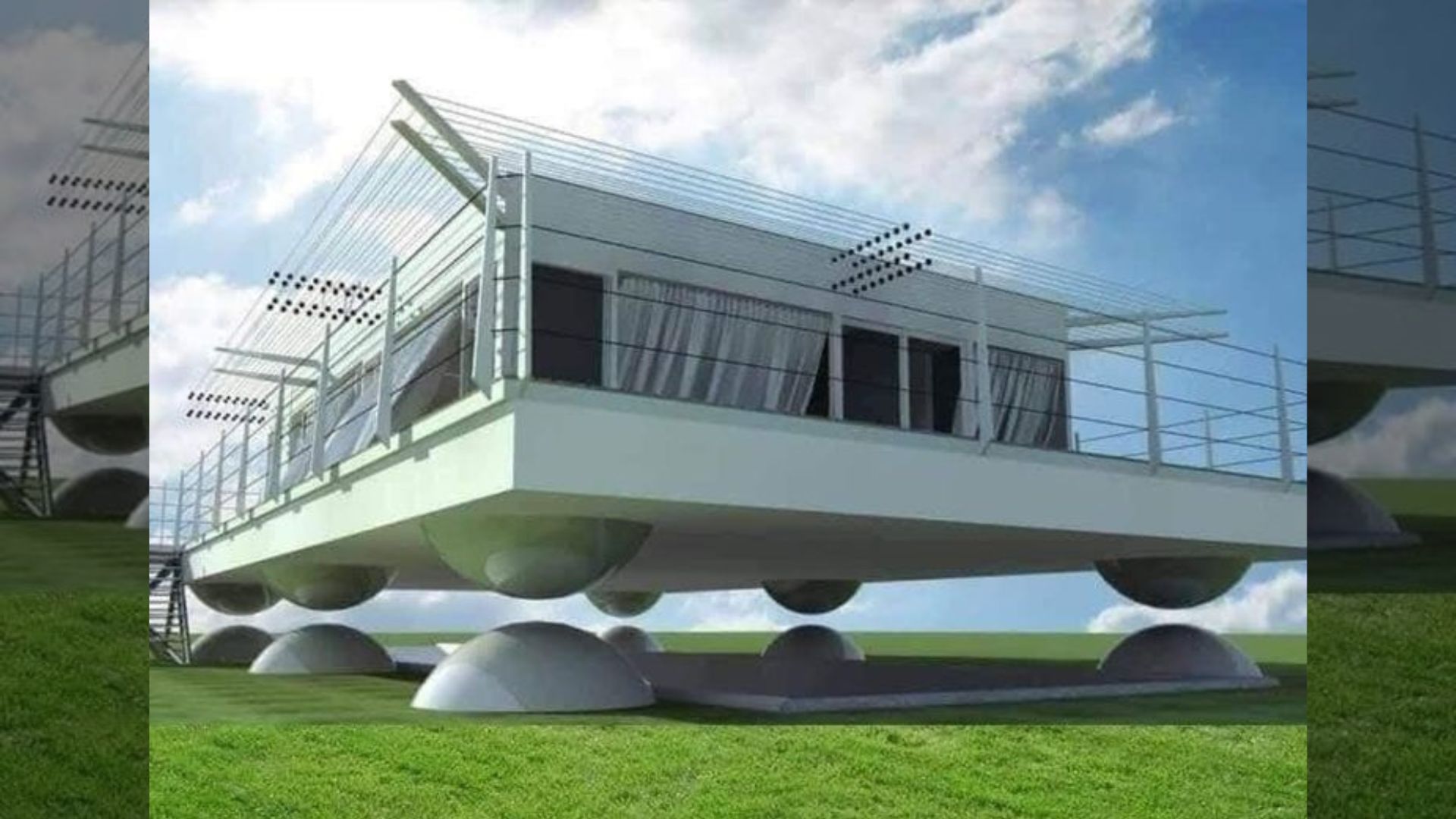

Imagine sipping coffee inside your home while the earth rumbles — and not a single thing spills. Sounds like a scene from a sci-fi movie, right?
But Japan just made that real.
Earthquakes Don’t Kill. Collapsing Buildings Do.
Let’s be real: when earthquakes hit, it’s not the shaking ground that gets us — it’s our buildings. Data from across the globe confirms that most fatalities during earthquakes happen due to collapsing homes and falling debris.
So Japan decided: if you can’t stop the quake, why not float above it?
Enter: Levitating Homes by Air Danshin
Japan-based company Air Danshin Systems has created an earthquake-resistant marvel. The concept is simple but genius:
✅ During calm times: The house rests on a deflated airbag
✅ During a quake: Sensors detect the tremor, triggering compressed air to inflate the airbag
✅ Result: The entire house lifts 3 cm off the ground and floats above the chaos
✅ After the tremors: The house gently returns to its base
During a dramatic live demo, the system handled simulated quakes so well that glasses of wine didn’t spill. Cheers to innovation!
Why We Desperately Need This Tech
Let’s take a quick look at some devastating earthquakes this century:
- 2004 Indian Ocean Earthquake (M 9.1) – 227,898 deaths
- 2010 Haiti Earthquake (M 7.0) – Over 160,000 killed
- 2011 Tōhoku, Japan (M 9.1) – Triggered a tsunami + Fukushima disaster
- 2023 Turkey-Syria Earthquake – Over 59,000 fatalities
- 2025 Myanmar and Thailand (M 7.7) – Over 3,600 fatalities in Myanmar alone and significant structural damage in Bangkok
Every one of these disasters had one thing in common: collapsing infrastructure.
How Does It Really Work?
👉 The system lifts the house 1–3 cm off the ground
👉 Uses seismic sensors and airbag inflation within 1 second
👉 Protects against side-to-side motion, which causes the most structural damage
👉 Can be retrofitted into existing houses or built into new ones
👉 Costs around 3 million Yen (~$37,000)
Caution : It’s not fool proof. If the initial quake is massive, the house might already be damaged before levitating. And it only protects from lateral movement — not upward jolts or floods.
Still, experts agree — this is a promising start.
Other Countries Are Innovating Too!
🔹 Turkey: New building codes mandate base isolation for hospitals and schools
🔹 USA (California): Experimenting with smart rebar and shock-absorbing foundations
🔹 Chile: Using flexible building materials to absorb quake energy
🔹 India: IITs are researching affordable base isolation for low-income housing
The global community is realizing that earthquake resilience isn’t a luxury. It’s a necessity.
DID YOU KNOW?
- The earliest seismoscope was invented in 132 AD by Zhang Heng in China!
- Dogs, elephants, and even chickens can often sense quakes before humans can.
- Japan records 1,500+ earthquakes every year — that’s about 4 a day!
The Bigger Picture
Air Danshin’s levitating house may not be a silver bullet — but it’s a giant leap in seismic safety tech. Just like airbags revolutionized cars, this could change how we think about our homes.
And remember: every bold innovation starts with an idea that sounds crazy at first.
What Do You Think?
Would you invest in a floating house for safety?
Do you think this tech can work in countries like India or Turkey?
Comment your thoughts below
Tag a friend who’s into science or architecture!

Leave a Comment