

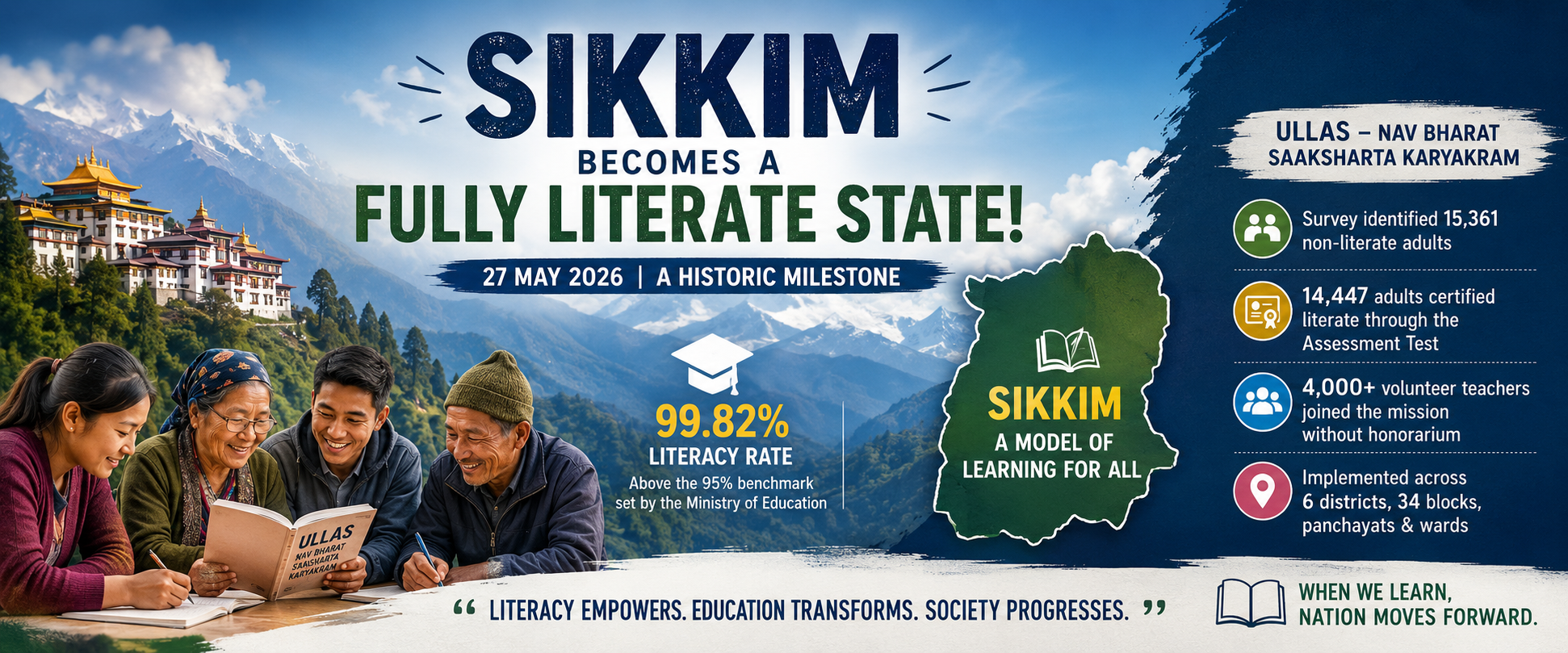

On 27 May 2026, Sikkim achieved a remarkable milestone. Chief Minister Prem Singh Tamang declared the state “Fully Literate” under the ULLAS – Nav Bharat Saaksharta Karyakram. With a literacy rate of 99.82 per cent, Sikkim surpassed the Ministry of Education’s benchmark of 95 per cent required for full literacy.
But this announcement is more than a success story for one state. It raises an important national question: if Sikkim, Mizoram, Goa, Tripura, Himachal Pradesh, and Ladakh can reach near-universal literacy, why do some Indian states still struggle to achieve similar progress?
What Is ULLAS?
ULLAS stands for Understanding of Lifelong Learning for All in Society. It is India’s national adult education programme launched by the Ministry of Education, aimed at promoting lifelong learning and ensuring that adults who missed formal education gain foundational reading, writing, and numeracy skills.
Sikkim launched the programme on 14 November 2022 and implemented it across all six districts, 34 blocks, Gram Panchayat units, and urban wards.
Under the programme, surveys identified 15,361 non-literate adults. Of these, 14,447 were certified as literate through the Foundational Literacy and Numeracy Assessment Test. Perhaps the most inspiring part of this campaign was the contribution of over 4,000 volunteer teachers—including school teachers and college students—who participated without honorarium.
Literacy Is More Than a Statistic
In India, literacy is often reduced to a percentage figure. However, the reality is far more complex.
A state’s literacy level is not determined merely by the number of schools it has. Social attitudes, government commitment, economic conditions, and community participation all play critical roles.
This explains why some states make rapid progress while others continue to struggle.
Why Do Some States Remain Less Literate?
1. Poverty and Economic Pressure
In economically weaker households, education often competes with immediate survival needs.
Children may be expected to work, help in family businesses, or take on household responsibilities. When families struggle to secure daily income, education can appear to be a luxury rather than a necessity.
This economic pressure contributes significantly to lower literacy rates.
2. Limited Access to Education
Many rural and remote areas still face serious infrastructure challenges.
Long distances to schools, poor roads, inadequate transport, shortages of teachers, and limited facilities create barriers to learning. These challenges are especially pronounced in tribal, mountainous, and isolated regions.
Access remains one of the largest obstacles to educational inclusion.
3. Social and Gender Barriers
In certain parts of India, traditional attitudes continue to affect educational participation, particularly for girls.
Early marriage, domestic responsibilities, and safety concerns may prevent girls from continuing their education. When half the population faces additional barriers, overall literacy rates naturally suffer.
Gender equality and literacy remain closely connected.
4. The Quality of Learning
Enrollment alone does not guarantee literacy.
A child attending school but unable to read, write, or perform basic arithmetic reflects a deeper educational problem. India has long faced what many education experts call a “learning crisis”—where students are present in classrooms but learning outcomes remain weak.
True literacy requires meaningful learning, not merely attendance.
What Makes Highly Literate States Different?
States with high literacy rates often share certain common characteristics.
Strong Political and Administrative Commitment
Education is treated not as a routine government scheme but as a social mission.
Sikkim’s ability to implement ULLAS across every block and local administrative unit reflects serious policy commitment and effective governance.
Community Participation
Government efforts alone are rarely enough.
The involvement of over 4,000 volunteer teachers in Sikkim demonstrates how community ownership can strengthen literacy campaigns. When society actively supports education, progress becomes faster and more sustainable.
Better Governance and Local Implementation
Several highly literate states have smaller populations or more manageable administrative structures, allowing programmes to be monitored effectively.
However, size alone is not the answer. Strong local governance and consistent implementation matter far more.
A Culture That Values Education
Perhaps the most important difference lies in social attitudes.
In states such as Mizoram, Himachal Pradesh, and Sikkim, education is often viewed not merely as a path to employment but as a source of dignity, social mobility, and civic responsibility.
When education becomes a cultural value, literacy naturally improves.
Is 95 Per Cent Literacy Enough?
This achievement also invites a deeper question.
Does being declared “Fully Literate” mean the educational journey is complete?
Probably not.
In today’s world, literacy extends beyond signing one’s name or reading basic text. Citizens increasingly need digital skills, media awareness, and the ability to evaluate information critically.
The future challenge is not simply basic literacy but functional and digital literacy.
What Can India Learn from Sikkim?
Sikkim’s success offers an important lesson.
Literacy improves when governments, communities, teachers, and volunteers work together with a shared purpose. Education cannot succeed through policy documents alone—it requires social commitment.
Sikkim has shown that literacy is achievable when treated as a collective mission rather than a bureaucratic target.
The state’s achievement deserves celebration, but it should also prompt reflection.
The real question is no longer whether India can achieve universal literacy. The question is whether every state is willing to invest the same seriousness, social energy, and long-term commitment that states like Sikkim have demonstrated.
Leave a Comment