



Legendary painter M F Husain’s painting ‘Untitled (Gram Yatra)’ sold at Christie’s for a staggering $13.8 million (Rs. 118 Crore) in New York. The painting considered as one of his most important and sizable works from the 1950s, sets the new record for the most expensive work of modern Indian art ever publicly auctioned.
The amount, which includes fees, shattered the auction house’s estimate of $2.5 million–$3.5 million and was more than four times Husain’s previous record of $3.1 million, which was set by his painting Untitled (Reincarnation) in September 2024 at Sotheby’s in London.
The sale broke the previous record for a modern Indian oil-on-canvas painting—Amrita Sher-Gil’s The Story Teller (1937), which was sold for about $7.4 million (Rs. 61.8 crore) by SaffronArt in New Delhi in September 2023. Earlier S H Raza’s painting Kallisté (1959), was sold in March 2024 at Sotheby’s for $5.6 million.
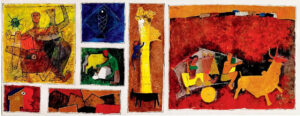
What’s So Special About the Painting?
Untitled (Gram Yatra), a mural-size painting that is nearly 14 feet long, is an artwork that took 13 years in the making and was completed in 1954. The painting comprises of 13 separate vignettes of village life in India, which is really important, because this is just few years after Indian independence. In the painting Untitled (Gram Yatra), Husain emphasizes the centrality of village and rural life in India as the basis for going forward as a new nation.
Each of the 13 panels portray different moments from village life from a woman dancing with a drummer, and another woman pounding flour to a standing farmer. The overall composition is anchored by a large central image of a man and woman riding an ox-drawn cart.
Nishad Avari, the New York–based head of Christie’s South Asian modern and contemporary art department, called the artwork “by far one of the most significant works” he’s seen in his career. Avari also noted that one of the 13 vignettes portrays a standing farmer—the only male figure in the piece. This is a self-portrait of sorts, and the only image which crosses into another vignette of a landscape with fields. “It’s literally a portrait of a farmer as a sustainer of the land and a protector of the land,” Avari said.
“The painting presents all the elements of Husain’s early practice on a single canvas – his bright and bold palette, folk subjects and imposing sculptural figures are complemented by calligraphic brushstrokes influenced by Chinese art, cubist forms, flattened figures, and even the whimsical influence of Paul Klee,” says a note accompanying the painting on the Christie’s website.
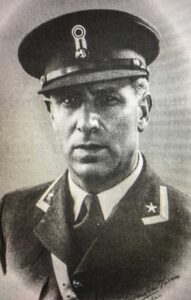
The Yatra of Untitled (Gram Yatra)
The original owner of the painting Untitled (Gram Yatra) was Leon Elias Volodarsky, a Ukraine-born Norwegian general surgeon who acquired the painting in New Delhi in 1954. A passionate art collector, Volodarsky had acquired the canvas for his Oslo home when posted in Delhi as head of a World Health Organisation team that was in India to establish a thoracic surgery training centre.
The work, which was exhibited at the All India Fine Arts & Crafts Society (AIFACS) in Delhi at a 1954 exhibition titled ‘M F Husain and Krishen Khanna’, was transported to Europe soon after.
Volodarsky’s estate donated the painting to the Oslo University Hospital in 1964. For seven decades, Untitled (Gram Yatra) remained largely hidden from public view as it was in a private neuroscience corridor in the Oslo University Hospital.
The 13-year process to get it to the auction block on March 19 included gaining the necessary permissions from the Oslo University Hospital’s board when the institution was finally ready to sell. The earnings are going to be used to set up a training centre for Oslo University Hospital doctors in Dr. Leon Elias Volodarsky’s name.
A True Homecoming
The painting has been acquired reportedly by Kiran Nadar, chairperson of the Kiran Nadar Museum of Art, following a fierce bidding war. Though Christie’s didn’t disclose the name saying the piece went to an “unnamed institution”. That’s believed to be the Kiran Nadar Museum of Art (KNMA).
Art historian and curator Yashodhara Dalmia describes the sale as “true homecoming” for M F Husain and the artwork. She says it is a major breakthrough for Indian art with regard to the market and raises the value of Indian art.
Husain’s artwork which is believed to be originally purchased by Volodarsky for Rs. 1,400 has not only set a new record for Indian art, but also marked the first time an Indian artwork has exceeded the Rs. 100-crore mark. This continues the extraordinary upward trajectory of the modern and contemporary South Asian art market
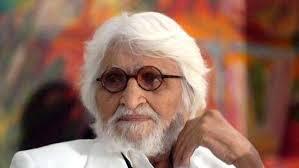
M F Husain- The Painter With a Camera
Maqbool Fida Husain is often known as India’s barefoot Picasso who painted narrative paintings in a modified Cubist style. Born on September 17, 1915 in Pandharpur in Maharashtra, M F Husain remains one of India’s most important and sought after artists whose works inspire art and conversations across the globe.
His themes—sometimes treated in series—included topics as diverse as Gandhi, Mother Teresa, the Ramayana, the Mahabharata, the British Raj, and motifs of Indian urban and rural life. An avid reader of history and mythology and Indian culture, a large part of Husain’s art includes paintings of gods and goddesses in the context of the politics of the time, works that put him in the crosshairs of controversy.
A founding member of the Progressive Artists Group, Husain and his contemporaries gave Indian art a new modernist language post- Independence. Founded in 1947, the Progressive Artists’ Group broke away from tradition and embraced modernist influences. Artists Husain, FN Souza, SH Raza, and Tyeb Mehta worked with bold forms and colours, and had an Indian sensibility. Though the group disbanded, their artworks still shape the global art market.
M F Husain had also directed films. In 1967, he received the National Film Award for Best Experimental Film for ‘Through the Eyes of a Painter’. This short film also received the Golden Bear award at the 17th Berlin Film Festival held in 1967. In 2000, Husain directed ‘Gaja Gamini’ with actress Madhuri Dixit who was also the subject of a series of his paintings. In 2004, he directed ‘Meenaxi: A Tale of Three Cities’, which was screened in the Marché du film section of the 2004 Cannes Film Festival.
Husain’s later art works have stirred controversy, which included nude portrayals of Hindu deities, and Bharat Mata. With FIRs and persistent death threats, Husain was forced into self-exile in 2006. He lived in Dubai and travelled to New York and London. Accepting Qatari citizenship in 2010, he passed away in exile in London on June 9, 2011 at the age of 95, leaving behind a phenomenal body of work.


Leave a Comment