



The tragic death of Anna Sebastian Perayil, a 26-year-old Ernst & Young employee in Pune has ignited a debate about toxic work culture. Anna passed away on 20 July, four months after joining S R Batliboi, a member firm of EY Global, as a chartered accountant.
The debate began after a letter from Anna’s mother, Anita Augustine, went viral in which she addressed Ernst & Young India chairman Rajiv Memani and blamed the workload and long hours for her daughter’s tragic demise. In a heart-wrenching letter, Anita blamed four months of EY’s callous attitude for her daughter’s death. She requested the EY India leadership to change a work culture that “seems to glorify overwork while neglecting the very human being behind the role”. The letter was shared multiple times on LinkedIn, including by the former employees of the company.
A Heart-wrenching Letter

Anita Augustine wrote that Anna worked till late nights, even on weekends, with no opportunity to catch her breath. She said Anna would return to her room utterly exhausted, sometimes collapsing on the bed without even changing her clothes, only to be bombarded with messages asking for more reports. She was putting in her best efforts, working very hard to meet the deadlines. She was a fighter to the core, not someone to give up easily. We told her to quit, but she wanted to learn and gain new exposure. However, the overwhelming pressure proved too much even for her.
Augustine said that no one from the company attended her daughter’s funeral. “After her funeral, I reached out to her managers, but I received no reply. How can a company that speaks of values and human rights fail to show up for one of its own in their final moments?” she wrote in the letter.
Conclusively, she added a powerful note on maintaining a healthy work culture in her letter: “It is time to reflect on the work culture within your organisation and take meaningful steps to prioritise the health and wellness of your employees. This means creating an environment where employees feel safe to speak up, where they are supported in managing their workload, and where their mental and physical well-being is not sacrificed for the sake of productivity.”
Response From EY India Chairman
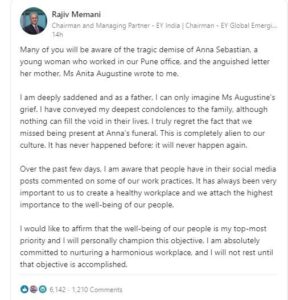
EY India Chairman Rajiv Memani reacted to the tragic demise of Anna Sebastian in a LinkedIn post. He said, “I truly regret the fact that we missed being present at Anna’s funeral. This is completely alien to our culture. It has never happened before; it will never happen again.” He did not address allegations of overwork in his post but several current and former EY employees attested to Anna’s account and said the consulting firm, one of the Big Four, was notorious for overworking its employees.
Responding to Memani’s LinkedIn post, one former EY employee spoke of his “terrible” experience with the firm. The ex-employee said that a director at EY asked him to work 17 to 18 hours a day. When he reported the director to HR, his complaint received no resolution. “When I reported this to HR, she suggested it might be due to client demands. Even when trying to voice my concerns, my colleagues often mocked me during team meetings,” he said.
Another comment read, “My son went through this nonsense years back. I was more fortunate. He left after 2 years but was completely burnt out. As parents we were worried if he would get back to work. It took him 6 months, but the memories don’t go. I remember how upset I used to be but never spoke up as he wouldn’t let me. You owe an apology to one and all who worked with this rotten organisation.”
Earlier, Rajiv Memani had said to The Indian Express, “We have around one lakh employees. There is no doubt each one has to work hard. Anna worked with us only for four months. She was allotted work like any other employee. We don’t believe that work pressure could have claimed her life.”
The 70-hour Work Week Debate Returns
The sudden and tragic death of Anna Sebastian Perayil has ignited a wave of reactions across social media, where thousands of users have shared their condolences, horror stories, and calls for accountability in corporate environments where long hours are often normalized and glorified. Many have demanded reforms in organisations like EY, calling for better mental health support, humane work conditions, and re-evaluating the pressures on young professionals.
One social media user linked Anna’s death to comments made by Infosys co-founder Narayan Murthy, who suggested that India’s youth should be prepared to work 70 hours a week to help the country progress.
Murthy’s remarks, made during a podcast with former Infosys HR director and board member TV Mohandas Pai, were to improve India’s productivity. Murthy highlighted that India’s work productivity is among the lowest globally and called on the younger generation to take responsibility for the country’s development. “My request is that our youngsters must say, ‘This is my country; I’d like to work 70 hours a week,’” he stated, sparking a national conversation on the feasibility and ethics of such a demand.
Need to Learn From ‘Karoshi’

To understand the relationship between work and productivity, one should look at Japan. The island nation has an unusual and terrifying phenomenon called “Karoshi”, which translates to “death due to overworking”.
The first documented case of Karoshi occurred in 1969 when a 29-year-old man working at a major Japanese newspaper company died from overwork-related complications. By 1988, nearly a quarter of male employees in Japan were working more than 60 hours per week. To address this issue, “Karoshi hotlines” that provided people with support and guidance were established by a group of lawyers and doctors.
Japan’s rapid post-World War II economic growth and demanding work schedules, often requiring 12 or more hours a day, 6-7 days a week, contributed to the Karoshi epidemic. Japan has some of the longest working hours in the world, yet its productivity has ranked lowest among G7 nations for the past 50 years.
To deal ‘Karoshi’, Japan is now contemplating four-day work weeks. However, many other parts of the world, including India, seem to be in the grip of karoshi culture.
Time For A More Balanced Approach
Organisations should set realistic expectations and should encourage employees to set achievable goals. Quality work often matters more than quantity. Companies should measure outcomes and should focus on the results employees achieve, rather than the hours they put in. This approach allows for greater flexibility and empowers individuals to manage their own time.
It’s high time to stop glorifying overwork and to change the perspective on work and success. Overwork may have been glorified in the past, but it is a fact that it’s an unsustainable and unhealthy approach. Promoting work-life balance can help organisations boost productivity, enhance employee well-being, and ensure their long-term success.
The tragic death of Anna Sebastian serves as a critical reminder for organizations to prioritize the mental well-being of their staff, especially those at the beginning of their careers. The pressures of modern corporate environments can lead to burnout and other mental health issues, making it essential for companies to foster a more compassionate and understanding work culture. By addressing issues of workload, offering support systems, and fostering open conversations about mental health, companies can create a more inclusive and caring environment.
Moreover, it is crucial that businesses recognize the humanity of their employees. No family should have to endure the loss of a loved one due to work-related stress, and Anna’s story serves as a call to action for all organisations to prioritize their employees’ well-being.


This blog connects recent events to the broader issue of toxic work environments, sparking a much-needed conversation about workplace culture and mental health.