

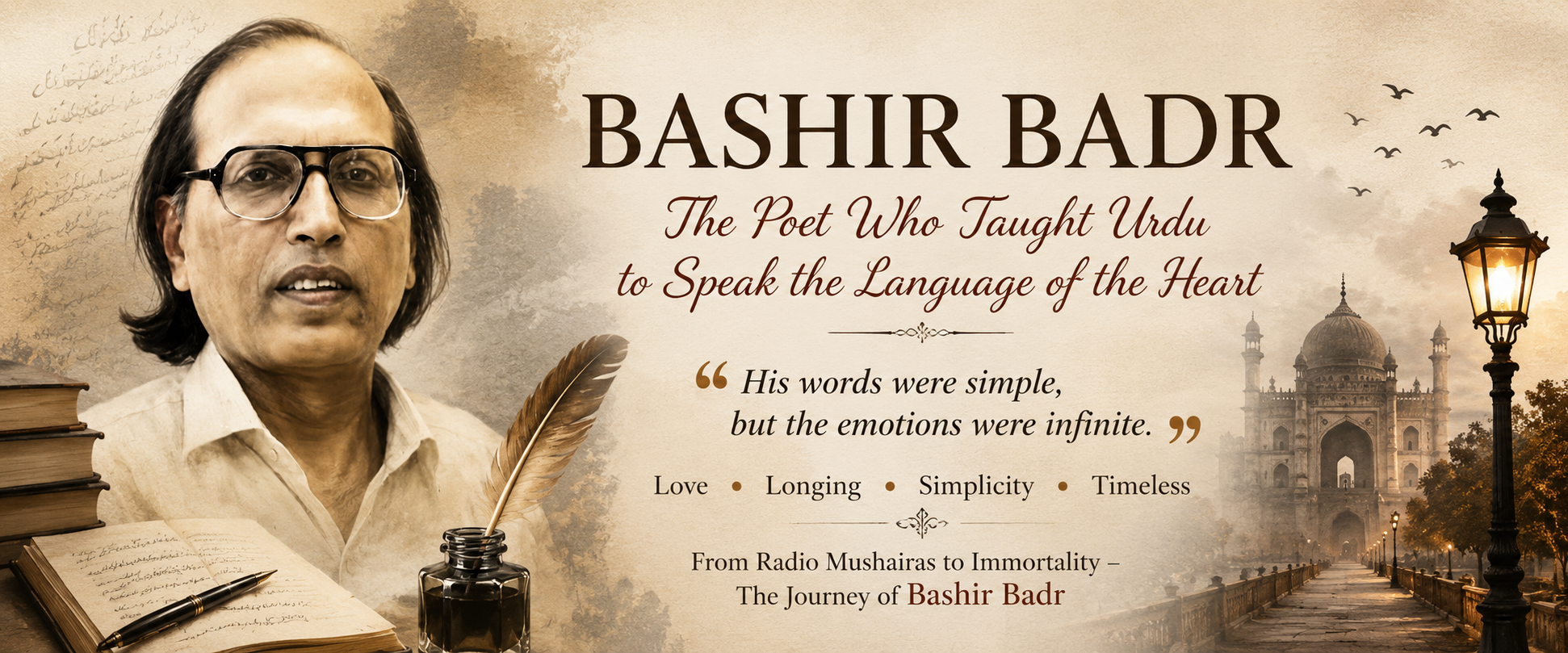

Some poets are admired. Some are memorised. And then there are poets whose words quietly become part of everyday life. Bashir Badr belonged to the last category.
Long before his couplets travelled through WhatsApp messages, social media captions, and mushairas across the subcontinent, Bashir Badr was simply a poet trying to find a stage.
His journey from literary obscurity to becoming one of the most beloved voices of modern Urdu poetry is not merely the story of a successful shayar. It is the story of resilience, friendship, simplicity, and the extraordinary power of words that speak directly to the heart.
The Poet from a Changing India
Born in 1935 in Ayodhya, Bashir Badr grew up in a world experiencing social and political transformation. His family later moved to Bhopal, a city that eventually became inseparable from his identity.
Unlike many traditional Urdu poets who leaned heavily on Persian and Arabic vocabulary, Badr chose a different path. His poetry was intimate, conversational, and emotionally transparent.
He studied at Aligarh Muslim University, where literature shaped his intellectual world. Interestingly, as former bureaucrat and poet Anis Ansari recalled, one of Bashir Badr’s poems had already entered the MA Urdu syllabus while he was still associated with the university.
This early recognition hinted at something remarkable: Bashir Badr was not merely writing poetry—he was reshaping modern Urdu expression.
A Poet Without a Stage
Success, however, did not arrive easily.
By the late 1960s and early 1970s, Bashir Badr was already publishing poetry in literary magazines and was recognised among serious readers of Urdu literature. Yet one crucial element was missing—public visibility.
Mushairas were the lifeblood of Urdu poetry.
A poet might publish endlessly, but unless audiences heard him recite, fame remained elusive.
His contemporary and friend Waseem Barelvi later remembered that Badr possessed talent but somehow struggled to break onto major stages. Determined to help emerging voices, Barelvi recommended him for mushairas in Meerut and Bareilly.
The results were disappointing.
The performances failed to create the magic everyone expected.
For many poets, such setbacks become the end of ambition.
For Bashir Badr, they became the beginning.
The Lucknow Turning Point
Every literary legend has a turning point.
For Bashir Badr, it came through chance, friendship, and a radio station in Lucknow.
In the 1970s, All India Radio’s Lucknow station organised one of the most prestigious radio mushairas in the country. Participation was considered the highest honour for an Urdu poet.
Waseem Barelvi jokingly compared it to winning the Nobel Prize.
When Barelvi himself received an invitation for the programme Kalam-e-Shair ba-Zuban-e-Shair, produced by Shahab Sarmadi, excitement mixed with concern.
He thought of Bashir Badr.
Instead of celebrating alone, Barelvi requested the organisers to invite another poet.
The request was accepted.
That poet was Bashir Badr.
The decision changed everything.
The AIR Lucknow appearance transformed his literary fortunes. Audiences who had never encountered him before suddenly discovered a poet whose language felt startlingly familiar—soft, intimate, and deeply human.
After Lucknow, there was no looking back.
The poet who once struggled for a stage became one of the brightest stars of Urdu mushairas.
Why Bashir Badr Felt Different
To understand Bashir Badr’s popularity, one must understand what Urdu poetry often sounded like before him.
Classical Urdu ghazals carried immense beauty, but their heavy Persian imagery and elaborate diction sometimes placed them at a distance from ordinary readers.
Badr changed that equation.
He wrote about love, loneliness, heartbreak, relationships, memory, and human dignity using language that felt lived rather than performed.
Former head of Urdu studies Prof Fakhre Alam observed that despite immense accomplishment, Badr remained remarkably humble. Yet his poetic talent, he said, was “as high as the sky.”
That humility reflected in his poetry.
There were no linguistic acrobatics for the sake of display.
No intellectual walls.
His verses invited readers in.
This accessibility helped modern Urdu poetry enter drawing rooms, classrooms, and everyday conversations.
The Sher That Traveled Everywhere
Many poets have famous lines.
Few create verses that live independent lives.
Bashir Badr achieved exactly that.
One of his widely loved couplets begins:
“Ujale apni yaadon ke hamare saath rehne do…”
The verse continues to echo through literary gatherings and radio programmes even today.
Its emotional appeal lies in its universality.
The poem speaks of memory not as burden but companionship—a quiet light carried through uncertain evenings of life.
This was quintessential Bashir Badr.
He transformed deeply philosophical emotions into intimate human conversations.
Another of his celebrated couplets reminds people to preserve dignity even during conflict:
“Dushmani jam kar karo lekin…”
The verse became so admired that even Pakistani leader Zulfikar Ali Bhutto reportedly quoted it during a visit to India.
Its message remains strikingly relevant:
Oppose fiercely if you must, but leave enough space for reconciliation.
In an increasingly polarised world, Bashir Badr’s poetry offered civility.
Love Without Ornament
Many admirers loved Badr because he proved that emotional depth does not require complicated language.
Poet Ajay Jain once remarked that love, longing, and loneliness were expressed by Bashir Badr with extraordinary simplicity.
That simplicity became his signature.
His poetry understood broken hearts without dramatics.
It recognised loneliness without self-pity.
It spoke of separation without theatrical despair.
Consider the spirit of another beloved thought associated with him:
“Parakhna mat…”
For countless readers, the verse became a lesson about relationships—that excessive judgment often destroys intimacy.
Bashir Badr did not merely write romantic poetry.
He wrote emotional wisdom.
Perhaps this explains why younger generations still rediscover him.
Bookstore owners and literary hosts often note that his collections continue to sell strongly among millennials. His lines move effortlessly between mushaira halls and Instagram captions because they contain emotional truths that resist ageing.
A Man of Extraordinary Simplicity
Literary fame often creates distance.
Bashir Badr resisted that tendency.
Culture enthusiast Jayant Krishna recalled hosting him once and being surprised when the celebrated poet arrived not with entourage or ceremony but in a public auto.
The evening unfolded over Lakhnavi food and poetry.
No protocol.
No airs.
Just conversation.
This simplicity became legendary among those who knew him.
He treated emerging poets warmly and generously.
Prof Nayyar Jalalpuri remembered making his own stage debut under Bashir Badr’s chairmanship and receiving not criticism but encouragement and a fatherly embrace.
Such stories reveal why affection for Bashir Badr extended beyond admiration for his poetry.
People loved the man as much as the poet.
Fire, Loss and Reinvention
Life, however, was not always gentle with him.
A devastating communal riot in Bhopal reportedly destroyed his home and manuscripts.
For a writer, the loss of unpublished work can feel like losing fragments of memory itself.
Yet Bashir Badr rebuilt.
His own poetic spirit reflected this resilience:
“Hum bhi dariya hain…”
The verse carries a profound belief in inner strength—that rivers find their own paths.
That belief mirrored his life.
He endured personal and social upheavals and continued writing.
His poetry never surrendered to bitterness.
Instead, it returned repeatedly to hope.
When Memory Betrayed the Poet
The final years of Bashir Badr’s life carried a painful irony.
The poet who spent decades preserving emotions through words gradually lost access to memory itself.
Dementia, which later developed into Alzheimer’s disease, altered his world.
Friends remembered heartbreaking moments when he struggled to recognise people once deeply connected to him.
Pervez Malikzada recounted how, after the death of a close friend, Bashir Badr could no longer remember him.
For admirers, the tragedy felt almost unbearable.
A poet whose work illuminated memory and relationships was eventually betrayed by his own brain.
And yet, illness could not erase his legacy.
His words had already escaped the boundaries of biography.
They belonged to readers now.
Why Bashir Badr Still Matters
In every age, poetry survives only if it speaks honestly to people.
Bashir Badr understood something timeless:
The human heart does not need complicated language.
It needs recognition.
His poetry recognised fear, tenderness, regret, hope, friendship, and reconciliation.
He brought Urdu poetry closer to common life without diminishing its elegance.
That achievement is why his work forms an essential foundation of modern Urdu literature.
Readers continue to carry his verses because they do not feel like literary performances.
They feel like conversations.
Perhaps that is why one of his most cherished lines continues to comfort generations:
“Musafir hain hum bhi…”
Life is a journey, the poet reminds us, and somewhere around an unexpected turn, meetings may happen again.
The Lasting Light
Bashir Badr passed away, but poets rarely disappear in the ordinary sense.
They remain where language survives.
In radio programmes.
In mushairas.
In classrooms.
In books passed between friends.
And most of all, in the private moments when someone reaches for words to explain longing, forgiveness, or hope.
Bashir Badr did not merely write Urdu poetry.
He taught Urdu poetry to speak in the language of everyday feeling.
That is why his voice still lingers—gentle, dignified, and unforgettable.
Leave a Comment