

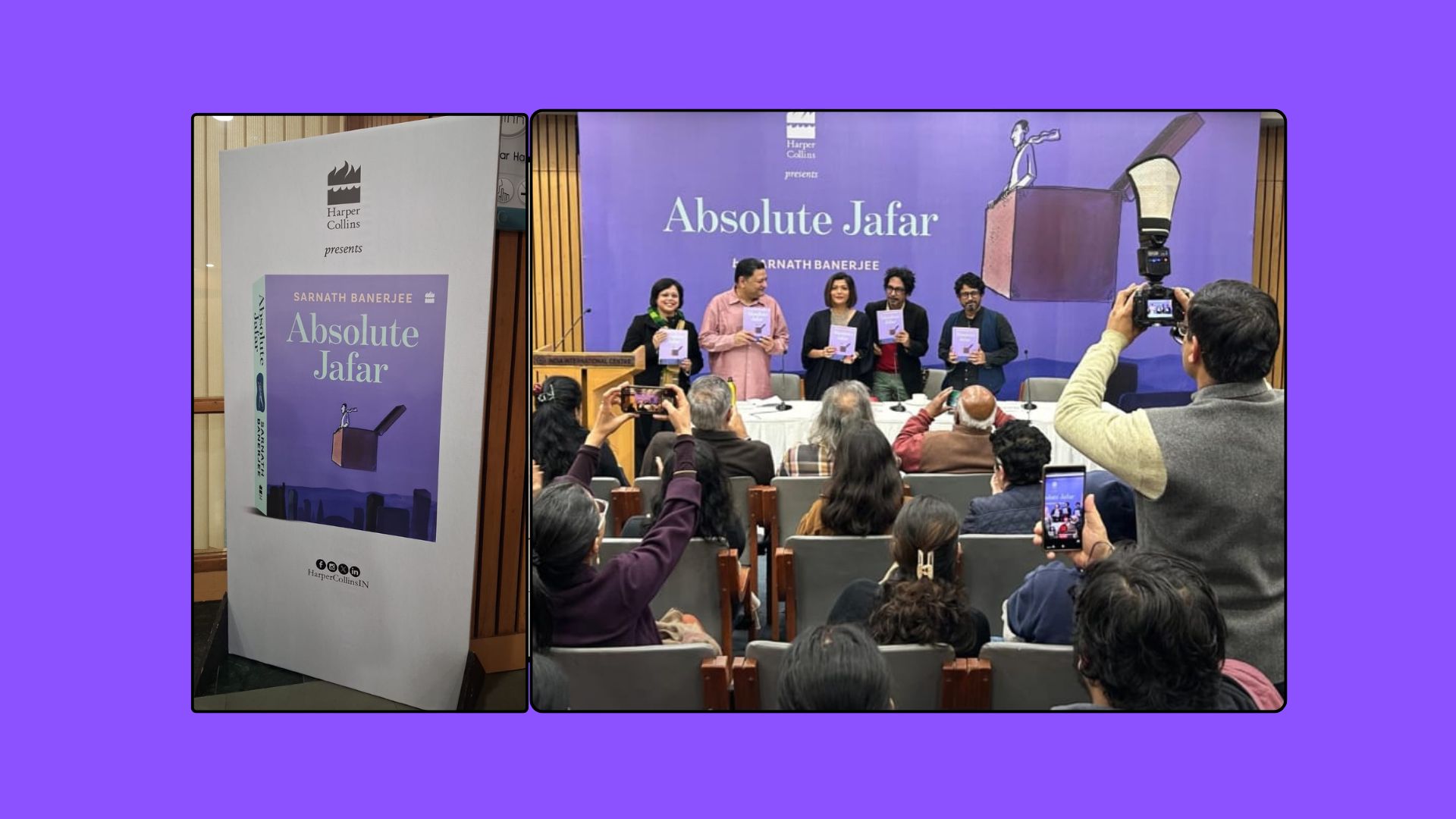

Last evening, on 5th February 2026, I attended the launch of Sarnath Banerjee’s latest graphic novel, Absolute Jafar, at the India International Centre. It was not just a book launch—it felt like stepping into a space of collective remembering.
Meeting Brighu, Arvind Desai, Mahrukh, and Jafar through Sarnath Banerjee’s words and illustrations was like being introduced to people who already existed somewhere in the folds of our own memories.
A World Shaped by Bureaucracy and Borders
Absolute Jafar is set in a world where bureaucracies and borders quietly but powerfully shape human relationships. It is perhaps Banerjee’s most personal work yet—a bittersweet rhapsody rich with wit, imagination, and deep humanity.
The story juxtaposes the life of Arvind Desai with Brighu, the author’s alter-ego. Desai is a “true-blue walker,” someone who steps out of his home and wanders through hotels, railway stations, and bars. The city speaks to him in ways that require no language. The sights and sounds narrate stories he has learned to read without words.
Brighu’s endless walking stayed with me. It mirrors a restlessness many of us feel—especially when home begins to feel less like a place and more like an idea.
And then there is this piercing line:
“Apart from that, walking is usually pleasurable, unless you belong to certain castes, races, or religions.”
The quote is illustrated through a powerful scene of a police officer rounding up a man solely because of his religion. The dryness of the humour makes it sharper. The satire does not shout—it lingers. And in that quietness, it makes the loudest noise.
Memory Beyond Photographs
During the discussion, Sarnath Banerjee shared a line from the book that felt deeply intimate:
“Remembering is important for me. It is true that photographs give visual information, but they don’t give me a fuller sense of the moment. It is what happens outside a photograph that matters to me.”
That idea stayed with me long after the session ended.
Home, like memory, slips away with time.
Sometimes, all that remains of a love story is a recipe.
And when it comes to family, there’s no knowing what one will inherit.
So what, if not stories, do we pass on?
Jafar’s inheritance is not property or legacy—it is stories. Fragmented, beautiful, incomplete, and impossible to fully escape.
Love Across Borders
The tender romance between Mahrukh and Brighu unfolds against the weight of Indo-Pak tensions. It is not merely a love story between two people; it is a story shaped—almost suffocated—by borders, internal politics, and bureaucracy.
The pain in their relationship does not feel dramatic. It feels inevitable. And that makes it more heartbreaking.
The narrative moves across Delhi, Calcutta, Berlin, and Karachi—cities that become repositories of memory. They are not just locations; they are emotional landscapes.
The Power of the Panels
One of the most striking aspects of Absolute Jafar is its visual storytelling. The panels are meticulously drawn, layered, and deeply expressive.
The monochrome sketches hold melancholy within them. When colour appears, it feels intentional—like hope seeping in quietly, hinting at the easing of tensions, at the possibility of something softer.
Words alone could not have carried this emotional weight. The illustrations add texture, silence, and atmosphere.
Why “Absolute Jafar”?
The title itself is inspired by a cricketing term. In cricket, an “absolute jaffa” refers to a delivery so perfectly executed that it is almost unplayable. It is brilliance in motion—the kind that leaves you stunned.
In many ways, the book feels like that. Precise. Unexpected. Impossible to ignore.
A Session to Remember
The book launch was a brilliant session filled with thoughtful conversations. Listening to Sarnath Banerjee speak about memory, ageing, belonging, and the quiet disappointments of life felt like listening to someone think out loud.
It was intimate, reflective, and quietly political.
In a world weighed down by wars, shrinking spaces for freedom of expression, and the looming anxiety of climate change, Absolute Jafar feels timely. It reminds us that art and literature are not just about storytelling—they are about preserving what might otherwise be erased.
Thoughtful, witty, and quietly heartbreaking, this graphic novel deserves not just a read—but a re-read.
If you haven’t picked up a copy yet, it’s out now at your nearest stores and online.
And if you do read it, don’t rush.
Some stories are meant to be walked through—slowly.

Leave a Comment