

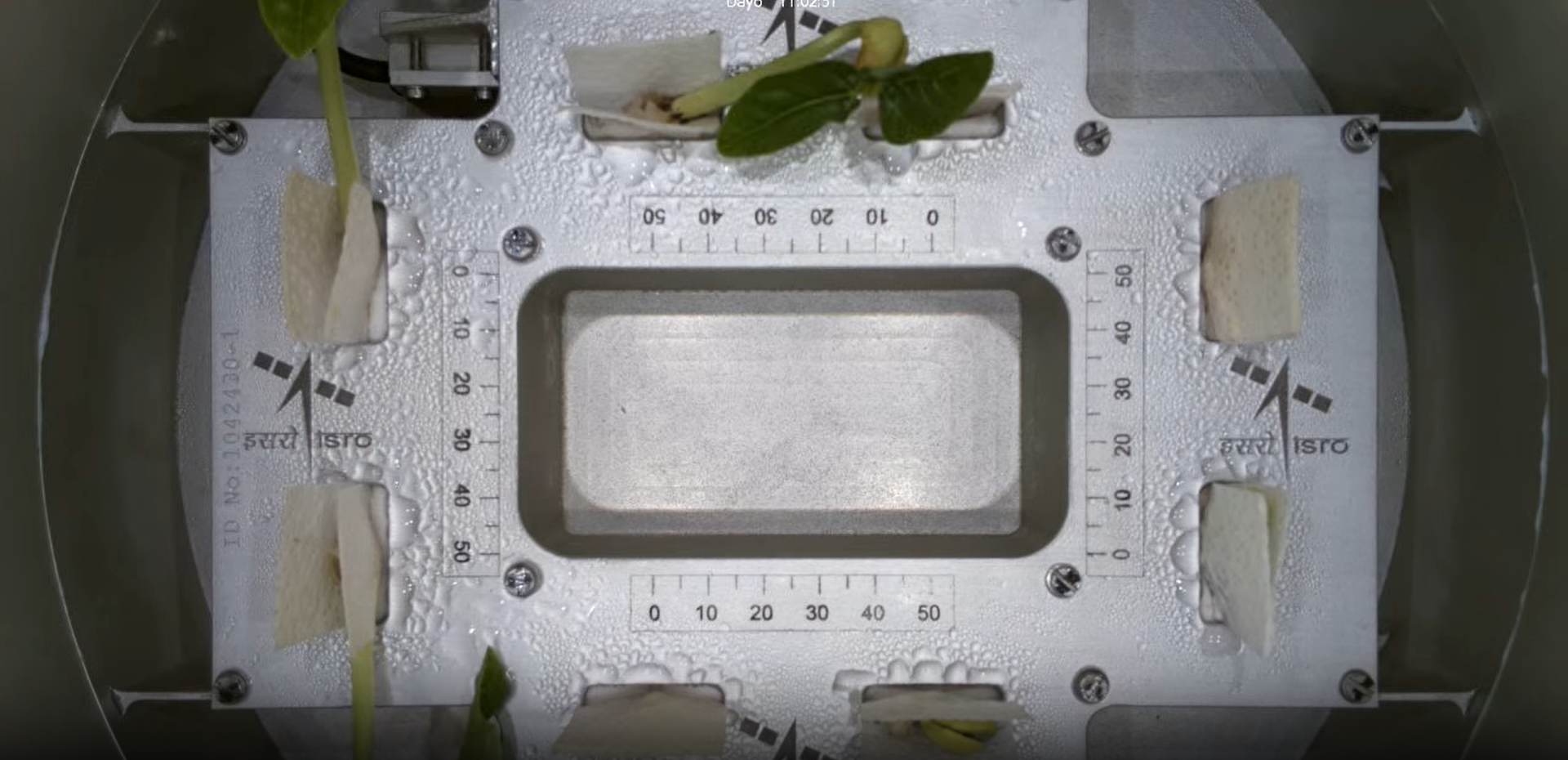

Ever wondered if plants can grow in space? Well, ISRO (Indian Space Research Organisation) just proved it’s possible! In a groundbreaking experiment, cowpea seeds sprouted leaves aboard the PSLV-C60 mission, marking ISRO’s first-ever biological experiment in space.
The Experiment: CROPS-1
The magic happened through CROPS-1 (Compact Research Module for Orbital Plant Studies)—an automated plant lab designed to grow and sustain plant life in space. Imagine a mini greenhouse floating above Earth, providing plants with everything they need—except gravity!
CROPS-1’s mission? To make seeds germinate and grow leaves in space. This tiny, high-tech container mimics Earth’s atmosphere with:
✅ 20.9% oxygen
✅ Controlled humidity (50-60%)
✅ Temperature between 20-30°C
Watering the seeds wasn’t simple. ISRO used a clever electric valve system to release water into a porous, clay-based soil medium—just enough to kickstart life without flooding the tiny space garden.
Fun Fact: Cowpea (scientific name: Vigna Unguiculata) was chosen because it germinates super fast—perfect for a time-limited space test.
How Did It Work?
- After 90 minutes in orbit, ISRO’s ground team sent a command to release water.
- Carbon dioxide levels began to rise—proof that germination had started!
- By Day 4, the seeds sprouted.
- By Day 5, tiny green leaves appeared—Mission Accomplished!
Cool Science Alert: Special cameras inside the CROPS module captured the entire process, while sensors tracked oxygen, CO₂, moisture, and temperature in real-time.
What’s Next for CROPS?
ISRO isn’t stopping here! The next mission will last 30 to 45 days, supporting plants beyond the two-leaf stage. The goal? Master the art of controlling oxygen, CO₂, and humidity to grow full-fledged crops in space.
From Sci-Fi to Reality – Just Like The Martian!
Remember Mark Watney growing potatoes on Mars in the movie The Martian? While that was Hollywood magic, ISRO’s CROPS-1 experiment just made a real breakthrough—cowpea seeds sprouted leaves in space! This milestone brings us closer to growing food during long-term space missions, turning science fiction into reality.
Other Countries Growing Greens in Space
ISRO is not alone in this cosmic gardening adventure!
The European Space Agency (ESA) has undertaken the Tropi experiments, which investigate how Arabidopsis plants respond to light in weightlessness, as well as under lunar and Martian gravity levels. These studies aim to uncover the mechanisms of plant growth in different gravitational conditions, providing insights essential for future space farming endeavors.
Similarly, the Japan Aerospace Exploration Agency (JAXA) has conducted the “Space Seed” experiment aboard the International Space Station (ISS). This long-term study focuses on understanding the effects of gravity on plant life cycles, which is vital for developing sustainable plant cultivation methods in space.
NASA has also been active in this field, with numerous plant growth experiments conducted on the ISS. These studies not only seek to answer fundamental questions about plant biology but also aim to improve plant growth on Earth.
ISRO’s recent success with the CROPS-1 experiment, where cowpea seeds sprouted leaves in microgravity, adds to this growing body of knowledge. Such experiments are crucial steps toward achieving self-sufficiency in food production during long-duration space missions, bringing the science fiction of “The Martian” closer to reality.
Did You Know?
- NASA grows veggies too! Their “Veggie” project grows lettuce and zinnias on the ISS.
- First plant in space? Arabidopsis (a tiny flowering plant) was the first to bloom in orbit in 1982.
- Why cowpea? It’s drought-resistant and grows quickly—ideal for extreme environments.
Why Is Space Farming a Big Deal?
- Food Security for Astronauts: Fresh produce reduces reliance on pre-packaged meals during long missions.
- Mental Well-being: Caring for plants provides comfort and improves mental health in the isolation of space.
- Future Mars Missions: Sustaining life on the Red Planet will require growing food in extreme conditions.
Did You Know?
- NASA astronauts ate space-grown lettuce for the first time in 2015.
- JAXA tested whether plants grown in space could produce seeds for future crops.
- ISRO chose cowpea seeds due to their quick germination—making them ideal for space experiments.
With ISRO pushing the frontiers, the dream of space farms is closer to reality. Imagine a future where astronauts pick fresh veggies while orbiting Earth!


Leave a Comment