



A small village in Japan is brimming with life-sized dolls who are being used not to decorate the area but to stave off loneliness among the locals. These life-sized dolls have become part of everyday life in Ichinono village, adding a sense of activity to an otherwise quiet community. These dolls are carefully crafted by villagers who wish to bring some sign of vibrancy to their ageing and dwindling population.
The life-sized dolls have been placed to replace all those who have left Ichinono village. The village now has less than 60 people living in it most of whom have retired. The village was slowly abandoned after younger people moved to nearby cities for work and education. Kids born in the tiny village eventually went to college in big cities, found jobs elsewhere, and never returned.
Feeling empty, the villagers began using old clothes to create colourful dolls that looked like their loved one and placed them around the area to mimic life. Now this new population of life-sized dolls outnumbers the people living in the village.
Paying the Price
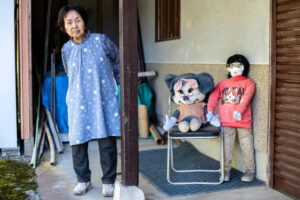
Hisayo Yamazaki, an 88-year-old widow says that they are probably outnumbered by puppets. Ichinono village once had big families with children living there but they were soon encouraged to go beyond the village to study. Parents feared that their children wouldn’t find suitable marriages or careers in such a remote place. “We’re now paying the price,” Hisayo said.
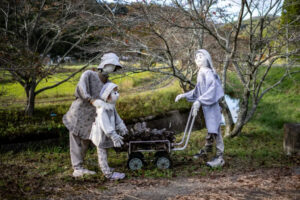
Villagers, like Hisayo Yamazaki, took it upon themselves to create mannequins that they wrapped in old clothing and positioned them at various points around town to make it seem like the “residents” were collecting firewood, swinging from a swing set, or riding bikes.
Mannequins resembling little girls and boys are placed all across the village to fill in for the children it lost. A mannequin of a little girl wearing a beanie hat sits on a wooden swing, while another one resembling her stands on a scooter. Another puppet child wears a red helmet and sits on a stationary bike. The village also has mannequins for adults. A couple of them resembling two women are seen watching on as another mannequin of a girl put logs in a cart.
But there is a shining ray of hope in the village—a 2-year-old named Kuranosuke. The little village recently had a new couple move in who chose to leave their life in a big city to look for a quieter alternative in Ichinono.
First Baby Born in 20 Years
Rie Kato, 33, and Toshiki Kato, 31, moved to the village from Osaka during the COVID-19 pandemic to get away from the bustling and congested city life. They moved as hybrid work became possible during the pandemic and have been there ever since.
They soon had a child and their two-year-old son, Kuranosuke Kato, became the village’s first baby in two decades. The baby is loved by all and is something of a celebrity around town. The older villagers cherish his presence, bringing him meals and watching over him collectively.
“Just by being born here, our son benefits from the love, support and hope of so many people – even though he has achieved absolutely nothing in life yet,” his father said. The community’s close-knit nature offers a deeper sense of belonging than urban anonymity. Toshiki has even begun refurbishing old houses to help preserve the village.
Village head Ichiro Sawayama noted that the villagers feel a sense of pride and hope in young Kuranosuke as he symbolises the continuation of life in their small community. Kuranosuke doesn’t have any kids to play with, not real ones anyway. But maybe one day, a younger couple with the kid moves to Ichinono so he can socialize with someone his own age.
Aging Population
Japan is facing a growing population decline crisis. Its population now has the highest percentage of people aged 65 and over in the world. The population of Japan is steadily decreasing, with people aged 65 and over now at a record high number of 36.25 million — making up nearly 30% of the total population. The country’s total population declined for the 15th consecutive year in 2023.
A new record low of only 730,000 babies were born, with an all-time high of 1.58 million deaths. People are dying at a faster rate than they can be replaced with new babies.
In Ichinono, the village leader, Ichiro Sawayama, warns that if something isn’t done, entire villages are at risk of extinction.
Prime Minister Shigeru Ishiba, who was elected on October 1, has pledged to revitalize small aging villages, but so far there hasn’t been much that’s proven to work. Ichinono is just one of more than 20,000 communities in Japan where most residents are 65 and above. The country, which doesn’t allow many immigrants, has the second-oldest population in the world, after Monaco.
In 2023, the Japanese government started offering residents ¥1 million per child (around $7,700 US) to couples in major cities who have children who are 18 years and younger so they can move into the less populated countryside. But there are not many takers.
All that is to say that the country can use a little bit of youth. And when real flesh and blood people aren’t having enough babies, life-size dolls are the next best thing which offer a way to simulate the energy that younger generations once brought.

Leave a Comment