

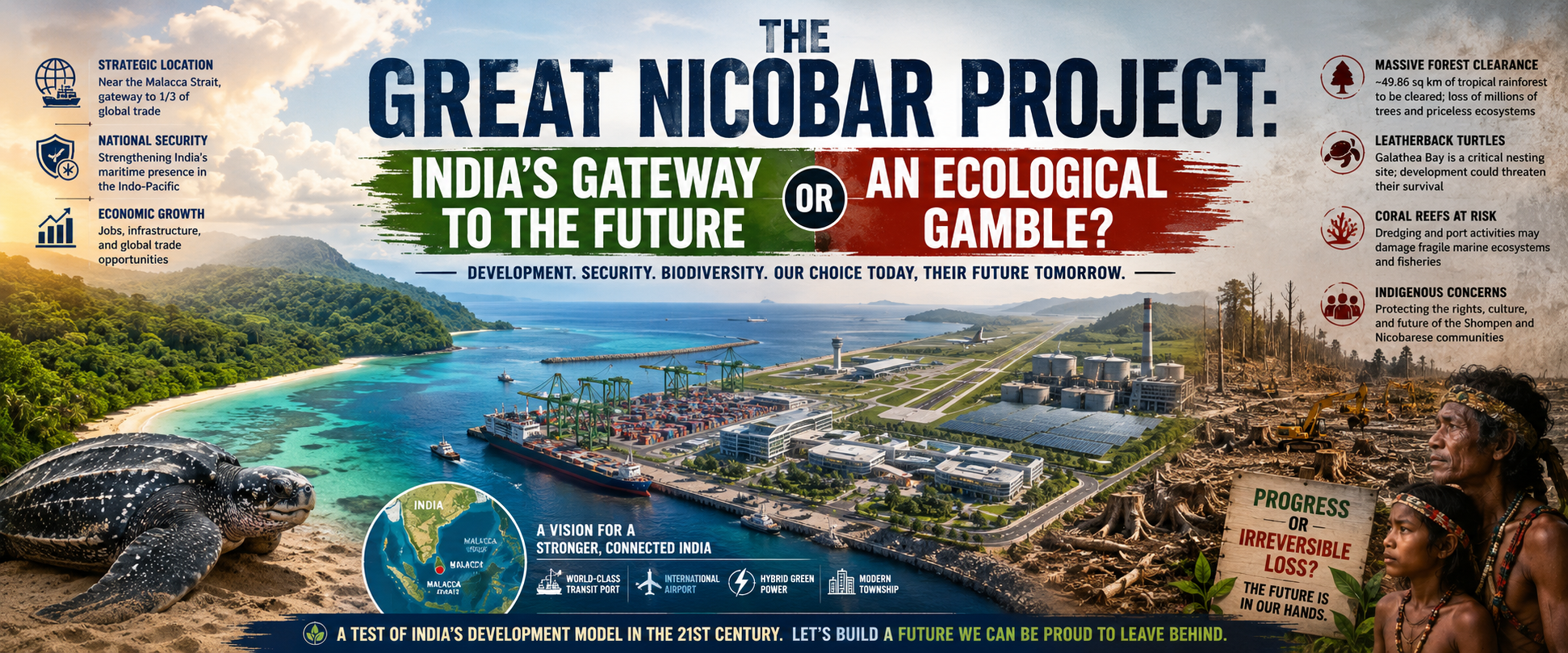

Deep in the eastern Indian Ocean, on the southernmost tip of India, lies Great Nicobar Island—a remote tropical paradise covered in dense rainforests, surrounded by coral reefs, and home to some of the world’s rarest species. Today, this island stands at the center of one of India’s most ambitious and controversial development plans: the ₹81,000 crore Great Nicobar Project.
Supporters call it a transformational investment that could reshape India’s position in global trade and security. Critics warn that it could irreversibly damage one of South Asia’s most fragile ecosystems.
So, what exactly is at stake?
A Mega Project with Global Ambitions
The Great Nicobar Project, officially known as the Holistic Development of Great Nicobar Island, is envisioned as a strategic infrastructure hub in the Indo-Pacific region.
The project consists of four major components:
- An International Container Transshipment Terminal at Galathea Bay
- A Greenfield International Airport with a 3,300-meter runway
- A 450 MVA hybrid gas and solar power plant
- A modern township designed to support future population and economic growth
Spread across approximately 166 square kilometers, the development aims to transform Great Nicobar into a major maritime and logistics center capable of competing with global transshipment hubs such as Singapore and Colombo.
Why Is the Island So Important?
Location is the key reason behind the project’s significance.
Great Nicobar sits close to the Malacca Strait, one of the world’s busiest maritime chokepoints. Nearly one-third of global trade and a substantial portion of Asia’s energy supplies pass through these waters every year.
Currently, much of India’s transshipment cargo is handled through foreign ports. By creating a world-class port on Great Nicobar, India hopes to reduce dependence on external facilities and capture a larger share of international shipping traffic.
The project also carries major strategic implications. As China expands its maritime presence across the Indian Ocean through ports and infrastructure projects often associated with the “String of Pearls” strategy, India sees Great Nicobar as an opportunity to strengthen its own influence and security capabilities in the region.
For policymakers, the project is not just about economics—it is also about geopolitics.
A Biodiversity Treasure Under Threat
While the strategic arguments are compelling, environmental concerns have become impossible to ignore.
Great Nicobar is not an empty piece of land waiting to be developed. It is one of India’s richest ecological landscapes and forms part of a UNESCO-recognized Biosphere Reserve.
The island hosts hundreds of unique plant and animal species, many of which are found nowhere else on Earth.
Environmental groups argue that the scale of construction could fundamentally alter this fragile ecosystem.
Massive Forest Clearance
One of the most controversial aspects of the project is the planned clearing of approximately 49.86 square kilometers of tropical rainforest.
Government documents indicate that millions of trees exist within the affected area, with hundreds of thousands expected to be removed during project implementation.
Unlike plantation forests, tropical rainforests are highly complex ecosystems that take centuries, sometimes millennia, to develop. Scientists argue that compensatory plantations elsewhere cannot fully replace the ecological functions of ancient forests.
The Leatherback Turtle Dilemma
Perhaps the most iconic species at risk is the Giant Leatherback Sea Turtle.
Galathea Bay, where the proposed transshipment terminal will be located, is one of the most important nesting sites for leatherback turtles in the Indian Ocean.
These turtles, already facing global population declines, depend on dark, undisturbed beaches for nesting. Increased shipping activity, construction noise, artificial lighting, and coastal modifications could disrupt breeding patterns and threaten their long-term survival.
Conservationists fear that losing such a critical nesting habitat could have consequences extending far beyond India’s borders.
Coral Reefs and Marine Ecosystems
The waters surrounding Great Nicobar contain extensive coral reef systems that support marine biodiversity and protect coastlines from erosion and storm surges.
Port construction typically requires dredging and seabed modification, activities that can increase sedimentation and reduce water quality.
Marine biologists caution that even relatively localized disturbances can have cascading effects on coral reefs, fish populations, and coastal ecosystems.
At a time when climate change is already placing enormous stress on coral reefs worldwide, additional human pressures could further increase ecological vulnerability.
The Human Story: Indigenous Communities
Environmental concerns are only one part of the debate.
Great Nicobar is also home to the Shompen and Nicobarese communities, among India’s most vulnerable indigenous populations.
The Shompen, in particular, are a semi-nomadic hunter-gatherer group that relies heavily on the island’s forests for survival. Their culture, traditions, and livelihoods have evolved in close connection with the natural environment.
Critics worry that large-scale infrastructure development, population growth, and increased outside access could disrupt their way of life even if direct displacement does not occur.
Many tribal rights advocates argue that the issue is not merely about physical relocation but about preserving cultural autonomy and ecological relationships that have existed for generations.
The Government’s Response
The Indian government maintains that environmental and social concerns have been carefully considered.
Officials emphasize that the project underwent multiple environmental assessments and regulatory reviews before receiving approval.
According to government statements:
- No displacement of indigenous communities is planned.
- Strict environmental safeguards have been imposed.
- Independent monitoring mechanisms have been established.
- Large-scale compensatory afforestation programs have been mandated.
- Biodiversity conservation measures are being integrated into project planning.
The government argues that sustainable development and environmental protection can coexist and that modern engineering solutions can minimize ecological damage while delivering strategic and economic benefits.
Development vs. Conservation: A Global Question
The debate surrounding Great Nicobar reflects a broader challenge facing nations around the world.
How should countries balance economic growth, national security, and environmental conservation?
Developing nations often require new infrastructure to improve competitiveness and create opportunities for future generations. At the same time, biodiversity loss and climate change have made environmental protection more urgent than ever.
Great Nicobar sits precisely at the intersection of these competing priorities.
The project could strengthen India’s position in global trade, enhance maritime security, and generate long-term economic benefits. Yet it also risks altering one of the country’s last relatively untouched ecological frontiers.
The Great Nicobar Project is more than an infrastructure initiative—it is a test of India’s development model in the twenty-first century.
Can a nation pursue strategic and economic ambitions while safeguarding fragile ecosystems and indigenous cultures?
The answer will not only shape the future of Great Nicobar Island but may also serve as a blueprint for how rapidly developing countries navigate the increasingly complex relationship between growth and sustainability.
Whether history ultimately remembers the project as a visionary achievement or a cautionary tale will depend on decisions being made today.
Leave a Comment