


“What do you want to become when you grow up?”
For most people, this question seems simple. Doctor. Engineer. Teacher. Artist.
But for some, the answer has always been: “All of the above.”
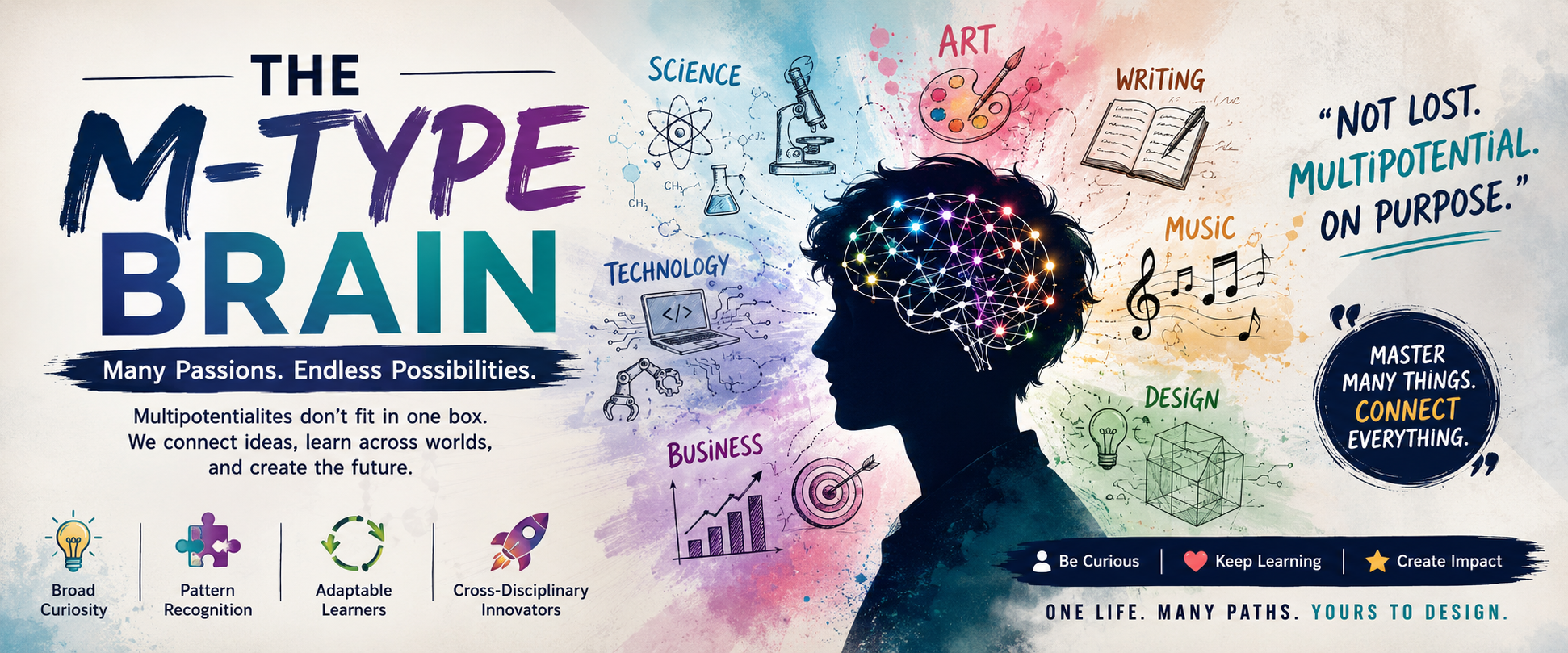
If you’ve ever been fascinated by science one month, filmmaking the next, and entrepreneurship after that, you may have what psychologists and career experts call an M-Type Brain—also known as a Multipotentialite.
In a world obsessed with specialization, M-Type individuals are proving that being curious about many things isn’t a weakness—it’s a superpower.
What Exactly Is an M-Type Brain?
The term “Multipotentialite” was popularized by career coach and writer Emilie Wapnick, who challenged the traditional belief that everyone must discover a single life purpose.
An M-Type person possesses multiple interests, talents, and passions. Instead of focusing deeply on one field for decades, they enjoy exploring different domains and connecting ideas between them.
Think of them as intellectual explorers.
They don’t just learn one language—they want to understand many.
They don’t see boundaries between disciplines—they see opportunities for connection.
The Science Behind It
Research in psychology suggests that creativity often emerges from combining ideas from unrelated fields.
Many groundbreaking innovations happened because someone brought together knowledge from multiple disciplines:
- Art + Technology
- Biology + Engineering
- Psychology + Business
- Mathematics + Music
This ability to make unexpected connections is called “associative thinking”, one of the strongest traits of multipotentialites.
Studies on creativity also show that people with diverse experiences are often better at problem-solving because they can approach challenges from different perspectives.
Signs You Might Have an M-Type Brain
1. You Fall in Love with New Subjects Quickly
You become obsessed with a topic, spend weeks learning everything about it, and then move on to something else.
Others call it inconsistency.
You call it curiosity.
2. Your YouTube History Makes No Sense
One day you’re watching astrophysics videos.
The next day it’s cooking tutorials.
Then filmmaking, psychology, history, and AI.
3. You Hate Being Put in a Box
When someone asks, “What do you do?” you struggle to answer because you do many things.
4. You Learn Fast
M-Type individuals often pick up new skills rapidly because they’ve already developed strong learning habits across multiple areas.
5. You Connect Unrelated Ideas
You often see links that others miss.
This ability frequently leads to innovation and creative breakthroughs.
Famous M-Type Thinkers in History
The world has always been shaped by people who refused to specialize.
Leonardo da Vinci
Perhaps history’s greatest multipotentialite.
He was:
- Painter
- Inventor
- Scientist
- Anatomist
- Engineer
- Architect
Centuries before modern innovation labs existed, Leonardo was blending art and science.
Benjamin Franklin
Franklin was:
- Writer
- Scientist
- Diplomat
- Inventor
- Political leader
His diverse interests helped shape modern America.
Maya Angelou
She wasn’t just a poet.
She was also:
- Author
- Actress
- Singer
- Activist
- Educator
Elon Musk
Whether one agrees with his methods or not, Musk’s career spans:
- Software
- Electric vehicles
- Space exploration
- Artificial intelligence
- Energy systems
His success largely comes from combining knowledge across industries.
Rabindranath Tagore
India’s own example of a multipotentialite:
- Poet
- Philosopher
- Music composer
- Painter
- Educator
- Social reformer
His work transformed literature, education, and culture.
The Biggest Problem: Society Loves Specialists
From childhood, we’re often told:
“Choose one thing.”
“Focus.”
“Stick to one career.”
But the modern world is changing rapidly.
Many jobs that exist today didn’t exist twenty years ago.
The most valuable people are increasingly those who can connect different fields, adapt quickly, and keep learning.
That’s where M-Type individuals shine.
The Hidden Struggles of Multipotentialites
Despite their strengths, M-Type people often face unique challenges.
The “Jack of All Trades” Fear
Many worry they’re not expert enough in any single area.
Yet history repeatedly shows that innovation often comes from breadth, not just depth.
Boredom
Once mastery is achieved, the excitement fades.
Routine can feel draining.
Career Confusion
Traditional resumes are built for specialists.
Multipotentialites often struggle to explain their diverse experiences in a single sentence.
How M-Type People Can Thrive
The Group Hug Career
Find work that combines multiple skills.
Examples:
- Entrepreneurship
- Product Management
- Consulting
- Journalism
- Content Creation
- Research
These careers reward versatility.
The Slash Career
Instead of being one thing, be many.
Examples:
- Writer / Photographer
- Engineer / Musician
- Teacher / YouTuber
- Designer / Entrepreneur
Increasingly, digital platforms make these careers possible.
Build a Personal Brand Around Curiosity
Rather than hiding your diverse interests, make them your identity.
People are often drawn to individuals who can explain how different worlds connect.
Why the Future Belongs to M-Type Minds
Artificial intelligence is automating routine tasks.
Information is everywhere.
The real competitive advantage is becoming the person who can connect ideas from different fields and create something new.
The future may belong not only to specialists—but also to curious generalists.
People who learn continuously.
People who adapt.
People who refuse to fit neatly into one category.
If you’ve spent years feeling guilty because your interests constantly change, perhaps there’s nothing wrong with you at all.
Maybe you’re not confused.
Maybe you’re simply wired differently.
The world needs specialists.
But it also needs explorers.
And every major leap forward in human history has been made by someone curious enough to wander beyond a single path.
That is the power of the M-Type brain.


Leave a Comment