


How a Warming Pacific Ocean is Shaping India’s Water Future
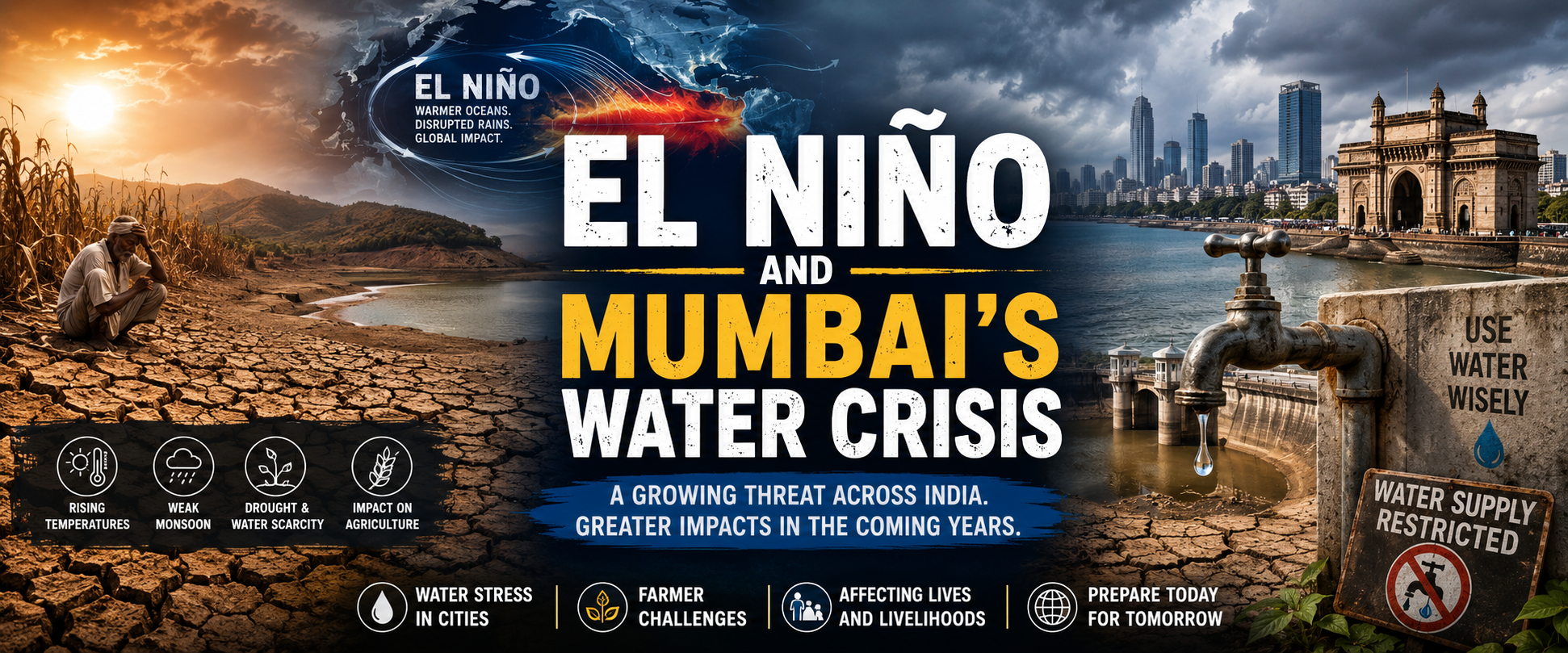
In June 2026, Mumbai found itself facing an alarming water crisis. Despite receiving monsoon showers, the city’s seven reservoirs remained critically low, forcing authorities to impose water cuts, restrict supply to construction projects, and limit industrial consumption. Mumbai’s struggle is not an isolated incident—it reflects a larger climate story unfolding across India, one closely linked to the return of El Niño and the growing impact of climate change.
As weather experts warn of a developing El Niño event in 2026, concerns are mounting over India’s monsoon, agricultural productivity, water security, and economic stability.
What is El Niño?
El Niño is the warm phase of the El Niño-Southern Oscillation (ENSO), a natural climate phenomenon that occurs when sea surface temperatures in the central and eastern Pacific Ocean become unusually warm.
Normally, strong trade winds push warm water toward Southeast Asia and Australia. During El Niño, these winds weaken, allowing warm water to move eastward toward South America. This shift disrupts global atmospheric circulation and changes rainfall patterns across the world.
Key Features of El Niño
- Weakening or reversal of trade winds
- Warmer-than-normal Pacific Ocean temperatures
- Reduced upwelling of nutrient-rich cold water off South America
- Significant changes in rainfall, temperature, and storm patterns worldwide
Although El Niño is a natural phenomenon, scientists warn that climate change is amplifying its impacts by increasing global temperatures and making weather extremes more severe.
Why Does El Niño Matter for India?
India depends heavily on the southwest monsoon, which supplies nearly 70 percent of the country’s annual rainfall. Historically, many drought years in India have coincided with El Niño events.
During El Niño years:
- Monsoon rainfall often weakens.
- Rainfall becomes uneven and unpredictable.
- Long dry spells occur between rain events.
- Heatwaves become more frequent and intense.
- Crop yields can decline.
- Food prices often rise.
In June 2026, India’s rainfall deficit reached over 40 percent in several regions, prompting the government to prepare contingency plans for hundreds of vulnerable districts. Authorities identified more than 300 districts at risk due to weak rainfall and limited irrigation infrastructure.
Mumbai’s Water Crisis: A Warning Sign
Mumbai, India’s financial capital, receives abundant rainfall during a normal monsoon. Yet in 2026, the city faced severe water shortages before the monsoon fully arrived.
By mid-June, water levels in Mumbai’s seven reservoirs had dropped to nearly 10 percent of capacity, forcing the Brihanmumbai Municipal Corporation (BMC) to impose water cuts and restrict supply to construction sites, swimming pools, and commercial establishments. Even after heavy rains, reservoir levels improved only marginally because rainfall in the city does not always translate into adequate inflow into reservoir catchment areas.
The crisis exposed a critical reality:
Rainfall Alone Does Not Guarantee Water Security
Water availability depends on:
- Reservoir storage capacity
- Catchment health
- Groundwater recharge
- Distribution efficiency
- Urban planning
- Water conservation measures
Climate variability is making rainfall increasingly erratic, creating situations where cities experience both flooding and water shortages within the same season.
Water Stress Across India
Mumbai is not alone. Several regions across India are experiencing growing water stress.
Maharashtra
Large parts of Maharashtra continue to face recurring drought-like conditions. Reservoir levels fluctuate dramatically due to erratic monsoons, affecting both agriculture and urban water supply.
Karnataka and Telangana
Major reservoirs have reported lower storage compared to previous years. Farmers increasingly depend on groundwater, accelerating depletion of aquifers. (
Tamil Nadu
Tamil Nadu remains one of India’s most water-stressed states due to limited river systems and highly variable rainfall patterns. Cities frequently depend on tankers and desalination plants during dry years.
Rajasthan and Gujarat
These arid regions are particularly vulnerable to prolonged dry spells associated with weak monsoons. Water scarcity directly affects agriculture, livestock, and rural livelihoods.
Himalayan States
Even traditionally water-rich regions face emerging risks. Glacial retreat and changing snowfall patterns threaten long-term river flows, potentially affecting millions downstream.
Impact on Agriculture and Food Security
Agriculture remains highly dependent on monsoon rainfall despite advances in irrigation.
A weak monsoon can lead to:
- Delayed sowing of crops
- Lower yields of rice, pulses, and oilseeds
- Increased irrigation demand
- Higher production costs
- Reduced farmer incomes
Government agencies have already advised farmers in vulnerable districts to shift toward less water-intensive crops such as millets and pulses.
Food inflation often follows poor monsoon years, affecting both rural and urban households.
What Could Happen in the Coming Years?
Climate scientists believe India may experience more frequent extremes in the future.
1. More Water Crises in Major Cities
Cities such as Mumbai, Bengaluru, Chennai, Hyderabad, and Delhi could face periodic water shortages despite receiving seasonal rainfall.
2. More Intense Heatwaves
El Niño years often coincide with higher temperatures. Combined with global warming, future heatwaves could become longer and deadlier.
3. Greater Flood-Drought Cycles
Instead of steady rainfall, India may see intense downpours followed by prolonged dry periods. This increases both flood risks and water scarcity.
4. Agricultural Uncertainty
Farmers will need climate-resilient crops, improved irrigation systems, and better weather forecasting to adapt.
5. Rising Economic Costs
Water shortages affect industries, power generation, transportation, and public health. Climate-related disruptions could cost billions of dollars annually.
What India Must Do
Addressing future water challenges requires long-term planning.
Strengthen Water Infrastructure
- Expand reservoir capacity
- Modernize pipelines
- Reduce leakage losses
- Improve urban water storage
Promote Rainwater Harvesting
Every city should make rainwater harvesting mandatory for residential and commercial buildings.
Protect Watersheds
Healthy forests, wetlands, and catchment areas improve groundwater recharge and reservoir inflows.
Improve Irrigation Efficiency
Drip irrigation, precision farming, and water-efficient crops can reduce agricultural water consumption.
Climate-Resilient Urban Planning
Cities must integrate water security into development plans instead of reacting only during crises.
Mumbai’s 2026 water crisis is more than a local emergency—it is a glimpse into India’s climate future. As El Niño alters rainfall patterns and climate change intensifies weather extremes, water security will become one of the country’s greatest challenges.
The coming years will test India’s ability to adapt to a world where rainfall is less predictable, temperatures are rising, and water resources are under increasing pressure. The lesson is clear: managing water wisely is no longer an option—it is a necessity for the nation’s future.


Leave a Comment