


What does it mean when a lake receives water after generations of waiting?
For many people, water flowing through a canal may look like another infrastructure milestone.
But in Gonur, Chitradurga, the arrival of Bhadra reservoir water in September 2026 carries a much bigger meaning.
It represents the first visible result of a decades-old demand from one of Karnataka’s drought-prone regions.
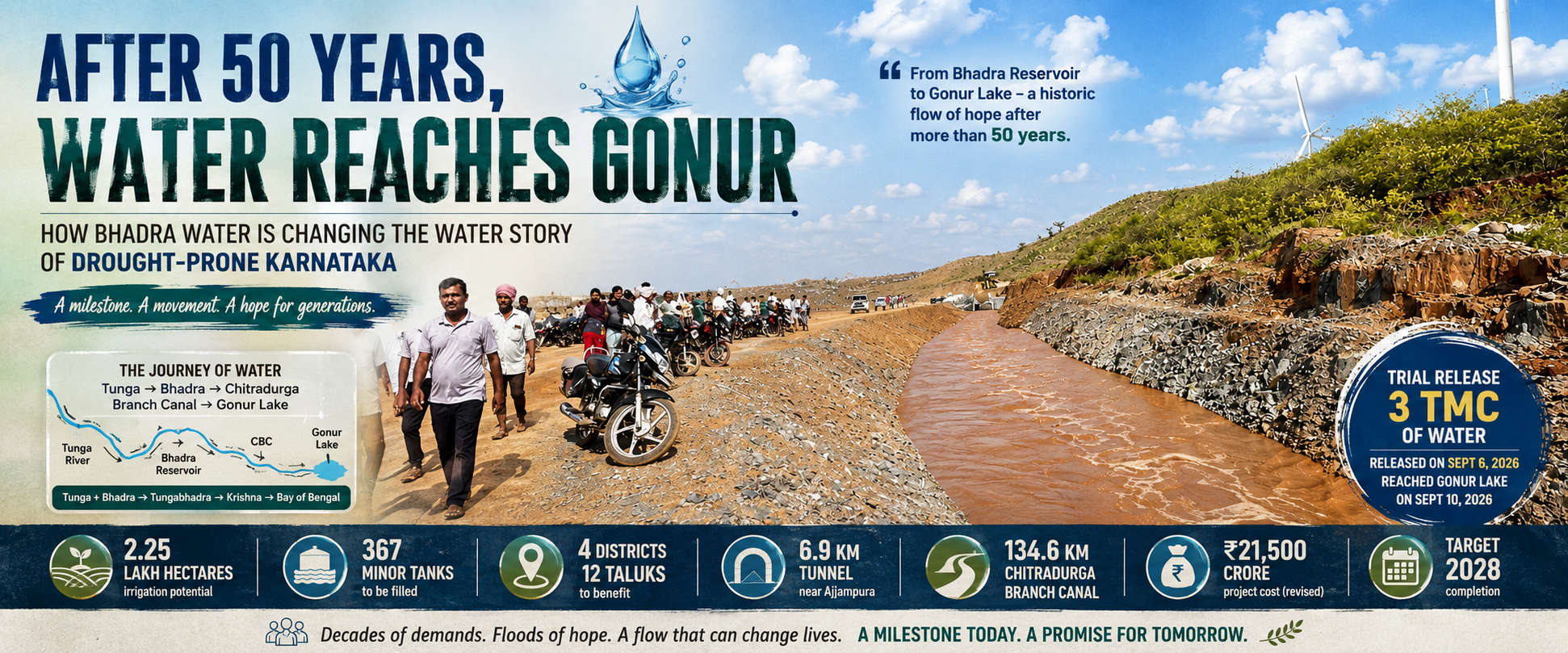
On September 6, 2026, about 3 TMC of water was released on a trial basis from the Bhadra Reservoir into the Chitradurga Branch Canal under the Upper Bhadra Project. Within days, the water reached Gonur Lake, marking a major milestone for Chitradurga.
For a region that has waited for this water for more than five decades, the sight of water entering the lake was not merely about engineering.
It was about hope.
But where did this water actually come from?
The story begins not at Gonur, but much farther away.
The Upper Bhadra Project is designed as a two-stage lift irrigation system.
Stage 1: Tunga → Bhadra
Water from the Tunga River is lifted and transferred towards the existing Bhadra Reservoir.
The project envisages lifting around 17.4 TMC from the Tunga.
Stage 2: Bhadra → Drought-prone Karnataka
Water from the Bhadra Reservoir is then lifted again and carried towards the drought-prone areas.
The second stage involves lifting around 29.9 TMC from the Bhadra Reservoir system, with the water moving through the project’s canal and a 6.9-km tunnel near Ajjampura before being distributed towards the branch canals.
From there, the water is divided towards areas including Chitradurga and Tumakuru.
And this is where the Chitradurga Branch Canal, or CBC, becomes crucial.
The 3 TMC trial run
The September 2026 release is important — but it needs to be understood correctly.
This is not yet the full operation of the Upper Bhadra Project.
Around 3 TMC was released as an experimental trial to test the system and move water towards Chitradurga. The larger project envisages a total allocation of about 29.9 TMC from the Tunga-Bhadra system.
Why only 3 TMC?
Because some of the supporting infrastructure — particularly works associated with drip irrigation and tank-filling systems — is still being completed.
In other words, the September release is a demonstration that the water can now travel through the system and reach its intended destination.
And it did.
From Bhadra Reservoir to Gonur Lake
The water travelled through the Chitradurga Branch Canal and eventually reached Gonur Lake in Chitradurga taluk.
The arrival was reported on September 10, following the trial release that began on September 6.
The CBC itself is a major piece of infrastructure.
Official project documents describe the Chitradurga Branch Canal as approximately 134.6 km long, designed to carry water towards drought-prone areas of Chikkamagaluru and Chitradurga districts.
So when people say that Bhadra water has finally reached Chitradurga, they are actually talking about an enormous chain of engineering works — reservoirs, pumping systems, canals, tunnels and distribution infrastructure.
Why Chitradurga needs this water so badly
Chitradurga lies in Karnataka’s semi-arid Bayaluseeme region, where rainfall is relatively uncertain and drought has repeatedly affected agriculture and water availability.
That makes irrigation infrastructure particularly important.
The Upper Bhadra Project has been designed to provide irrigation support to approximately 2.25 lakh hectares and to help fill 367 minor irrigation tanks across drought-prone areas of Karnataka.
The project covers areas across four districts:
- Chitradurga
- Tumakuru
- Chikkamagaluru
- Davanagere
and around 12 taluks are expected to benefit.
The potential impact therefore goes far beyond one lake.
Why filling lakes matters
One of the most interesting aspects of the project is that its objective is not simply to send water directly to farms.
The plan includes filling hundreds of tanks and lakes.
Why?
Because surface water bodies can help support groundwater recharge, while also providing local water storage.
That can potentially create a chain reaction:
Canal water → tanks/lakes → groundwater recharge → wells → agriculture
This is particularly significant in drought-prone areas where farmers often depend heavily on groundwater.
So the success of the project should ultimately be measured not merely by kilometres of canal constructed, but by whether it creates reliable and sustainable water availability on the ground.
A project whose cost kept rising
The Upper Bhadra Project also tells an important story about the economics of large irrigation projects.
According to the Karnataka government minister’s recent account, the project was initially estimated at around ₹2,814 crore.
The estimate subsequently increased to approximately:
₹5,500 crore → ₹12,500 crore → ₹21,500 crore
under successive revisions and governments.
Around ₹11,500 crore has reportedly been spent so far.
That raises an important public-policy question:
When a project takes decades to complete, who ultimately pays the price of delay?
It isn’t only the government.
It is also the farmer waiting for irrigation, the family depending on a local water source and the village watching groundwater levels fall.
Is Upper Bhadra actually a “National Project”?
Here comes an important fact-check.
You may see social-media posts describing Upper Bhadra as Karnataka’s first irrigation project to receive National Project status.
The story is more complicated.
The Central Water Commission’s records show that the Upper Bhadra Project was recommended for inclusion under the National Projects scheme in 2022.
However, a February 2025 Rajya Sabha reply from the Ministry of Jal Shakti explicitly stated that the Union government had not declared Upper Bhadra a National Project.
This distinction matters.
Recommended for National Project status ≠ formally declared a National Project.
It is an excellent example of why infrastructure stories need fact-checking beyond political claims and social-media headlines.
And there is a fascinating river story behind it
The name “Bhadra” is not accidental.
The Bhadra River rises in the Western Ghats and flows eastward across Karnataka.
The Bhadra eventually meets the Tunga River at Koodli near Shivamogga.
Together, the two rivers form the Tungabhadra.
And the Tungabhadra is itself an important tributary of the Krishna River.
So the water reaching Gonur has travelled through a fascinating network of Karnataka’s river geography.
Tunga + Bhadra → Tungabhadra → Krishna → Bay of Bengal
A local lake in Chitradurga is therefore connected to one of India’s major river systems.
DID YOU KNOW?
Did you know #1
3 TMC sounds abstract — but TMC means “Thousand Million Cubic Feet.”
It is a huge volume of water used commonly in large Indian irrigation and reservoir projects.
Did you know #2
The Upper Bhadra system involves lifting water twice — first towards the Bhadra Reservoir and then from Bhadra towards the drought-prone areas.
That is why it is called a lift irrigation project.
Did you know #3
The project includes a 6.9-km tunnel near Ajjampura as part of the second-stage conveyance system.
Did you know #4
The larger project aims to irrigate around 2.25 lakh hectares and support the filling of 367 minor irrigation tanks.
Did you know #5
The project has been discussed and pursued for several decades. The current milestone is therefore the result of efforts by multiple governments, elected representatives, farmer organisations and activists rather than a single administration.
Did you know #6
The Chitradurga Branch Canal is itself more than 130 km long according to project documentation.
Did you know #7
The project is not just about Chitradurga. Its planned benefits extend across four districts and 12 taluks.
50 years of waiting — but is the story over?
Not yet.
This is perhaps the most important point.
The arrival of water at Gonur is a milestone, not the finish line.
The trial has demonstrated that water can reach Chitradurga through the branch canal. But the larger promise of the project depends on completing the remaining infrastructure, establishing the intended distribution network and ensuring that the water actually reaches farms and local water bodies.
The current target being discussed by Karnataka authorities is completion by 2028.
So the next question should not simply be:
“Has Bhadra water reached Chitradurga?”
It should be:
“When will every promised component of the project become operational — and when will the farmer actually see the benefit?”
That is the real test.
From a canal project to a social transformation
If implemented as planned, Upper Bhadra could change much more than irrigation statistics.
More reliable water can influence:
Agriculture → farm income → rural employment → local businesses → migration → village economies
And filling tanks could potentially strengthen local water security and groundwater conditions.
But large water projects also need responsible water management.
Because transferring water from one basin or region to another is never simply about moving water from Point A to Point B.
It involves questions of river flows, competing demands, ecological requirements, groundwater, irrigation efficiency and equitable distribution.
That is why the success of Upper Bhadra will ultimately depend on what happens after the water reaches the lake.
The image that says it all
For someone seeing Gonur Lake today, it may simply look like water entering a lake.
But behind that water are:
decades of demands,
farmers’ movements,
political debates,
engineering challenges,
financial revisions,
canals and tunnels,
pumping stations,
and generations waiting for a more secure future.
After more than 50 years, Bhadra water has finally reached Gonur.
Now comes the bigger challenge:
Can this historic flow become a permanent flow of opportunity?
Because the real success of Upper Bhadra won’t be measured by how dramatically the water arrived.
It will be measured by how sustainably that water changes lives.

Leave a Comment